On this page
- What Is Glass Wool Insulation?
- Benefit 1: Reliable Thermal Control
- Benefit 2: Useful Fire Performance Options
- Benefit 3: Acoustic Absorption
- Benefit 4: Lightweight Handling and Flexible Installation
- Benefit 5: Broad Building Applications
- Benefit 6: Product Choice Across Different Assemblies
- Benefit 7: Service Life When the System Is Protected
- What Should Buyers Verify?
- How Should Buyers Compare Suppliers?
- FAQ About Glass Wool Insulation
- Conclusion: Verify the Benefit, Not Just the Label
- Standards and Editorial Sources
Glass wool insulation combines thermal control, sound absorption, low weight, and flexible product formats in one material family. These benefits explain its use in walls, roofs, ceilings, partitions, pipes, and industrial equipment. The right product can simplify installation and improve building performance, but no benefit should be assumed from the material name alone.
For project buyers, the useful question is not simply, “Is glass wool good?” It is, “Does the quoted glass wool match this assembly, climate, performance target, and approval route?” This guide explains the advantages and the evidence needed to confirm them.
What Is Glass Wool Insulation?
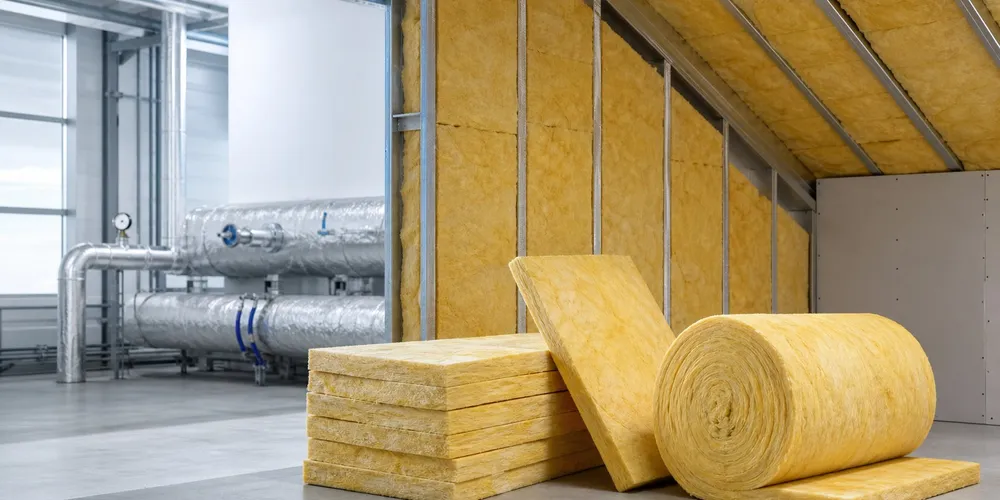
Glass wool is a man-made mineral fiber material formed from a glass-based melt. Fine fibers create a porous mat with many small air spaces. This structure resists heat flow and can absorb sound energy when it is installed as part of a suitable building or equipment assembly.
Common Glass Wool Product Forms
Manufacturers supply rolls, blankets, batts, boards, and formed pipe sections. ISO 8144-1:2026 covers certain bonded mineral wool mats for ventilated building spaces and notes that facings fall outside its scope. Buyers must therefore check both the insulation and its facing.
Why Product Form Changes the Result
Rolls suit broad roof or ceiling areas, boards fit defined cavities, and pipe sections reduce cutting around round services. The formats are not automatically interchangeable.
Benefit 1: Reliable Thermal Control
Glass wool insulation limits heat transfer by trapping air within its fiber network. The material does not “create cold” or “create heat.” It slows heat flow between spaces at different temperatures, helping the designed wall, roof, or equipment system maintain more stable conditions.
Compare Conductivity at the Same Temperature
Thermal conductivity is meaningful only with its test method, mean temperature, thickness, and tolerance. Buyers should request data for the quoted grade and use project calculations to select thickness.
Installed Performance Depends on Workmanship
Gaps, heavy compression, missing pieces, and thermal bridges can reduce the expected result. A continuous layer with carefully fitted joints generally performs more predictably than a nominally better material installed with interruptions.
Benefit 2: Useful Fire Performance Options
Glass fibers are inorganic, but that fact alone does not prove that every finished glass wool product has the same reaction-to-fire class. Binders, facings, adhesives, substrates, thicknesses, and mounting conditions can affect the tested construction.
Read the Complete Fire Classification
Buyers should request the classification, test route, specimen description, report date, and field of application. The European construction-products framework uses harmonized methods to communicate characteristics such as reaction to fire, thermal conductivity, and sound insulation. A short label without the supporting product scope is not enough for project approval.
Do Not Confuse Reaction and Resistance
Reaction to fire covers product behavior under defined exposure. Fire resistance covers how a complete element maintains functions for a period. Glass wool is not a substitute for a tested fire-rated assembly.
Benefit 3: Acoustic Absorption
The porous fiber structure can absorb sound energy. This makes glass wool useful inside partitions, ceilings, and equipment enclosures when combined with suitable framing, boards, seals, and surface layers.
The Assembly Matters More Than Density Alone
Higher density does not guarantee a better result in every wall. Ask for relevant acoustic data because boards, framing, seals, and penetrations also affect performance.
Benefit 4: Lightweight Handling and Flexible Installation
Glass wool is relatively light and can be cut to fit many cavities and curved surfaces. The U.S. Department of Energy describes fiberglass and mineral-wool rolls and batts as flexible products available in widths suited to common wall-stud, attic, and floor-joist spacing.
Less Weight Does Not Remove Site Controls
Low weight can reduce handling effort, but installers still need the current safety data sheet, suitable protective equipment, clean cutting methods, and good housekeeping.
Protect the Installed Material
Keep insulation dry and correctly supported. Repair damaged facings and poorly sealed joints before closing the assembly.
Benefit 5: Broad Building Applications
Applications include framed walls, partitions, roofs, ceilings, floors, metal buildings, and selected service assemblies. Each needs its own specification.
Glass Wool Wall Insulation
Glass wool wall insulation can fill cavities between metal or timber studs. In external walls, the designer must also address thermal bridges, wind and water control, vapor movement, fixings, and cladding. In internal partitions, acoustic junctions and perimeter seals deserve close attention.
Glass Wool Roof Insulation
Glass wool roof insulation is available as rolls, batts, and boards for suitable roof and ceiling designs. The installer must preserve required ventilation paths and coordinate vapor-control layers, roof penetrations, supports, and weather protection.
Industrial and Pipe Uses
Boards, blankets, and pipe sections can insulate compatible equipment and pipework. Define temperature, condensation risk, cladding, vibration, and maintenance access before selection.
Benefit 6: Product Choice Across Different Assemblies
Glass wool insulation for buildings comes in different thicknesses, dimensions, densities, and facings, allowing selection by cavity, installation, finish, and performance needs.
Match the Facing to the Purpose
A facing may finish or reinforce a blanket and may contribute to vapor control. Do not treat all facings as equivalent; request composition, joint treatment, evidence, and instructions.
Benefit 7: Service Life When the System Is Protected
Glass wool can provide long service when installed within its limits and protected from water, damage, compression, and uncontrolled air movement.
Durability Is a System Result
No supplier should promise unchanged performance in every condition. Manage moisture, supports, interfaces, damage, and maintenance, and rely on product-specific declarations.
What Should Buyers Verify?
Before ordering, buyers should review the following points:
- Thermal control: Request conductivity data, the test method, mean temperature, thickness, and tolerances. Check for risks from gaps, compression, thermal bridges, and moisture.
- Fire performance: Request the complete classification and specimen scope. Confirm whether the facing, binder, adhesive, substrate, and mounting method match the proposed product.
- Acoustic absorption: Review product or assembly test data and remember that results depend on the complete construction.
- Installation: Confirm dimensions, recovery, cutting, and fixing guidance. Poor fit can interrupt the insulation layer.
- Application suitability: Check the declared use and installation instructions. One grade may not be suitable for walls, roofs, and pipes at the same time.
- Durability: Review dimensional and moisture-related data where applicable, and plan protection against damage, wetting, and unsupported installation.
- Documentation: Request the datasheet, reports, labels, and traceability records. A logo or certificate may not cover the exact model being ordered.
How Should Buyers Compare Suppliers?
Send each supplier the same requirement sheet covering application, dimensions, facing, targets, destination, quantity, packing, and documents. This supports a fair comparison without inventing an industry average.
A Seven-Point Procurement Check
- Match the product form to the wall, roof, pipe, or equipment assembly.
- Compare thermal data at equivalent test conditions.
- Review complete fire and acoustic evidence where required.
- Confirm facing, joints, supports, and moisture-control details.
- Check tolerances, packing, labels, and batch traceability.
- Verify that certificates apply to the exact product and market.
- Obtain consultant or authority approval before bulk purchasing when required.
FAQ About Glass Wool Insulation
1. What are the main benefits of glass wool insulation?
Glass wool insulation can provide thermal resistance, sound absorption, useful fire-performance options, low weight, and flexible formats. The buyer should verify each benefit against the exact product datasheet and the intended assembly rather than relying on a generic claim.
2. Is glass wool insulation for buildings suitable for large projects?
Yes, it can suit large projects when dimensions, performance data, packing, and supply consistency are confirmed. Kingsenda states that it has served customers in more than 165 countries and reports annual exports of 30 million pieces. There is no universal audited industry average for these company metrics, so buyers should request traceable documents and project-specific supply details before comparing suppliers.
3. How should I choose glass wool wall insulation?
Choose it by cavity depth, required thermal or acoustic performance, framing layout, facing, moisture strategy, and approval requirements. The material should fit without major gaps or excessive compression, and evidence should match the proposed wall construction.
4. What should I check when ordering glass wool roof insulation?
Check the roof type, thickness, dimensions, facing, vapor-control plan, ventilation space, fixing method, fire evidence, and packing. Kingsenda reports that it can provide CE, RoHS, and FCC-related documentation; buyers should confirm which document is relevant to the exact insulation product and destination market because a company-level claim does not automatically approve every item.
5. What are common applications of glass wool insulation in buildings?
Common applications include framed walls, internal partitions, pitched roofs, ceilings, floors, metal-building systems, and selected service-insulation assemblies. Product form and installation details should be chosen separately for each location.
6. Is all glass wool insulation for buildings the same?
No. Products can differ in thickness, dimensions, density, facing, thermal data, acoustic behavior, fire classification, and intended use. Compare documents for the quoted model and avoid applying one report to a different construction.
Conclusion: Verify the Benefit, Not Just the Label
Glass wool offers a useful combination of thermal, acoustic, fire-related, handling, and application benefits. Its real value comes from matching the product to the assembly and protecting the installation from gaps, compression, moisture, and damage. Project buyers should compare consistent technical evidence, confirm the destination-market requirements, and record the approved specification before ordering.
For a Kingsenda quotation, prepare the application, drawings or cavity dimensions, thickness, facing, quantity, destination, and required documents. This information allows the supplier and project team to review the same specification.
Standards and Editorial Sources
- ISO 8144-1:2026 — Mineral wool mats for ventilated spaces
- U.S. Department of Energy — Energy Saver Guide: insulation types
- European Commission — Construction Products Regulation Working Plan 2026–2029
- Company scale and documentation statements are supplied by Kingsenda and should be checked against current order-specific records.