On this page
Elastomeric foam insulation is a flexible, closed-cell material used on HVAC pipes, chilled-water systems, refrigeration lines, ducts, and industrial equipment. Its main strengths are condensation control, low heat transfer, flexibility, and relatively simple installation. Its limitations include restricted service temperatures, compression risk, outdoor weathering, and performance that depends heavily on sealed joints.
For project buyers, the right question is not whether rubber foam is always better than another insulation. The useful question is whether the selected product, thickness, vapor-control detail, and protective finish match the operating conditions. This guide explains the elastomeric foam insulation advantages and disadvantages that matter during specification and purchasing.
What Is Elastomeric Foam Insulation?
Elastomeric foam insulation is a flexible polymeric foam with a predominantly closed-cell structure. Many commercial products use nitrile rubber-based formulations, often described as NBR or NBR/PVC, while other formulations may use EPDM or different polymers. The exact composition should come from the product data sheet rather than a general category description.
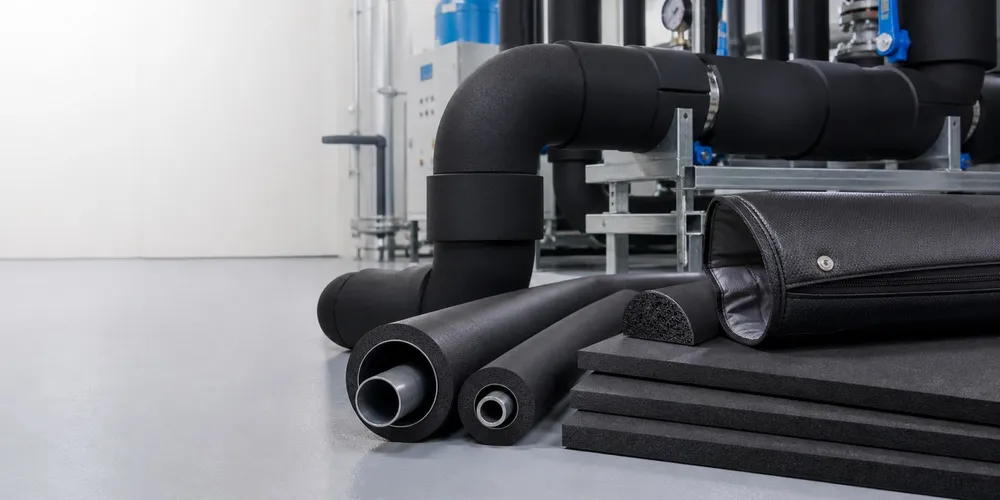
The material is supplied as tubes, sheets, and rolls. Tubes fit common pipe sizes, while sheets and rolls cover ducts, vessels, larger pipes, and irregular equipment. Its flexibility helps installers form the insulation around elbows, valves, flanges, and other fittings.
How the Closed-Cell Structure Works
A closed-cell structure contains many small cells that are largely separated from each other. These cells trap gas and limit internal air movement, which helps reduce heat transfer. The same structure can also resist water-vapor movement better than an open, fibrous structure when the material and all joints remain intact.
This does not make every rubber foam product waterproof or eliminate the need for careful installation. Cuts, open seams, damaged surfaces, and compressed areas can interrupt the insulation and vapor-control layer.
Main Advantages of Elastomeric Foam
The strongest benefits appear in cold-service and HVAC applications where thermal control and condensation resistance must work together.
Low Thermal Conductivity
Rubber foam can provide low thermal conductivity in a compact, flexible layer. The source document gives a general range of about 0.032 to 0.038 W/(m·K), but a buyer should not use this range as a universal guarantee. Declared values vary by formulation, test temperature, density, aging condition, and test method.
Compare supplier data only at the same mean temperature and under equivalent test conditions. A lower number on one sheet is not automatically better if the measurement conditions differ.
Condensation Control
Condensation control is a major reason to use elastomeric insulation for chilled water pipes. When warm, humid air reaches a surface below the local dew point, water can form on the pipe or insulation surface. Proper insulation raises the outer surface temperature and limits water-vapor movement toward the cold pipe.
The required thickness depends on pipe temperature, ambient temperature, relative humidity, airflow, surface emissivity, and installation details. A fixed thickness cannot prevent condensation in every climate or mechanical room.
Flexible Installation
Rubber foam pipe insulation is easy to cut and shape with suitable tools. Installers can fit tubes around straight runs and fabricate pieces for elbows, tees, valves, and flanges. The material’s flexibility is particularly useful in congested plant rooms and retrofit projects.
Installation speed should not replace workmanship. End joints, longitudinal seams, penetrations, and supports still need full contact and approved adhesive treatment.
Lightweight Material
Elastomeric foam is relatively light and places limited additional load on normal HVAC pipework and equipment. Lightweight tubes and rolls are also easier to handle on site than many rigid insulation systems.
The supporting structure must still be designed for the pipe, fluid, insulation, cladding, and operating loads. Soft insulation should not be expected to carry concentrated loads at hangers without an approved support detail.
Nitrile Rubber Insulation Pros and Cons
Nitrile rubber insulation pros and cons are closely linked to its flexible closed-cell construction. That construction supports moisture resistance and easy fitting, but it also means the material can deform under sustained pressure and needs protection in demanding environments.
Limitation: Temperature Range
Elastomeric foam is not the default solution for boilers, exhausts, steam lines, or other high-temperature services. Service-temperature limits vary substantially by formulation and application. The commonly repeated range in general articles should never replace the manufacturer’s data for the exact product.
Buyers should check continuous and intermittent temperature limits, pipe surface temperature, adhesive limits, and any restrictions at joints or facings. Mineral fiber or another high-temperature insulation may be more appropriate when the design exceeds those limits.
Limitation: Compression Damage
Rubber foam is flexible and can compress beneath pipe supports, equipment feet, clamps, or external impact. Compression reduces local thickness and can create a thermal bridge. It may also open nearby seams.
Load-bearing inserts, shields, and suitable protective coverings help control this risk. The correct detail depends on pipe diameter, load, movement, temperature, and condensation conditions.
Limitation: UV and Weather Exposure
Unprotected elastomeric foam can age when exposed to sunlight and outdoor weather. Surface chalking, cracking, or loss of flexibility may follow if the product is used beyond its declared exposure capability.
Outdoor work commonly needs a compatible coating, PVC jacket, aluminum cladding, or metal covering. The protection system must resist local weather and remain sealed without damaging the foam underneath.
Limitation: Fire Classification Is Specific
Fire performance must be evaluated from the complete classification report for the exact product. Formulation, thickness, facing, adhesive, substrate, mounting, and test method can affect the result. A general phrase such as “flame retardant” does not prove suitability for every building or market.
Buyers should request the relevant report and confirm the edition, specimen description, validity, and intended use. Project acceptance remains subject to the specification and local authority.
Closed Cell Rubber Insulation for HVAC
Closed cell rubber insulation for HVAC is commonly considered for chilled-water pipes, condensate drains, refrigeration suction lines, heating water services within product limits, ducts, and mechanical equipment.
Chilled-Water and Condensate Pipes
Cold pipes need an unbroken thermal and vapor-control layer. Open seams, exposed metal, and crushed support points can allow condensation even when the main insulation thickness is adequate.
Designers should calculate thickness using project temperatures and humidity. Installers should seal every longitudinal seam, butt joint, fitting, and termination according to the selected system.
Rubber Foam Pipe Insulation Selection
Selection should begin with application data, not price per meter. A useful request for quotation includes the pipe material and diameter, operating temperature, ambient conditions, required thickness, indoor or outdoor exposure, quantity, packaging, and documentation needs.
Check Technical Data Under Equal Conditions
Compare thermal conductivity at the same mean temperature. Check water-vapor resistance using the same test basis, and read the complete fire classification rather than a short label. Confirm dimensional tolerances, density where relevant, service temperature, and compatibility with adhesive and coatings.
Do not create a numerical “industry average” unless an independent dataset defines the products, methods, and sample size. Product-specific evidence is more useful than an unsupported market number.
Check Installation and Protection Needs
Include adhesive, cleaner, tape where specified, support inserts, protective coating, and cladding in the project cost. A low material price can be misleading if the system needs extra labor or protection in its final environment.
Inspect stored materials for damage and keep them clean and dry. During installation, avoid stretching the foam, compressing it at supports, or hiding open joints beneath a jacket.
Buyer Checklist
Before ordering, confirm the following items:
- Application and pipe or equipment type.
- Operating and ambient temperature ranges.
- Relative humidity and condensation risk.
- Required insulation thickness and dimensions.
- Thermal-conductivity value and test condition.
- Water-vapor performance and joint-sealing method.
- Complete fire test or classification evidence.
- Indoor, outdoor, UV, weather, and impact exposure.
- Adhesive, coating, cladding, and support compatibility.
- Batch identification, packaging, and traceable documents.
Frequently Asked Questions
What Are the Main Elastomeric Foam Advantages?
The main advantages are flexible installation, low heat transfer, and useful resistance to water-vapor movement when the closed-cell material and its joints remain intact. These features make elastomeric foam practical for chilled-water and HVAC pipework, but buyers should verify the exact conductivity, temperature limit, and fire evidence for the quoted product.
Kingsenda states that it has served customers in more than 165 countries, holds CE, RoHS, and FCC certifications, and reports annual exports of 30 million pieces. These company-provided figures describe supply experience and documentation, not a guaranteed performance advantage over every mainstream product. Buyers should confirm that each certificate and report applies to the exact model, thickness, and destination market before placing an order.
Is Elastomeric Insulation Right for Chilled Water?
Elastomeric insulation for chilled water pipes can be a strong choice because closed-cell rubber foam combines thermal resistance with vapor-control capability. It works only when the design thickness is appropriate for the pipe temperature and ambient humidity, and when seams, fittings, supports, and terminations are fully sealed.
Its disadvantages also matter. Compressed supports, damaged surfaces, open joints, or outdoor exposure without protection can reduce performance. There is no reliable universal industry-average value that proves one product will prevent condensation everywhere. Ask for project-specific thickness calculations, comparable test data, and installation instructions, then inspect the completed system before it is concealed.
Conclusion
Elastomeric foam insulation offers a useful balance of thermal control, condensation resistance, flexibility, and installation efficiency for many HVAC and chilled-water applications. Its main limitations are temperature restrictions, compression, weathering, and dependence on careful joint sealing. The best selection comes from matching product data and system details to real operating conditions. Buyers should verify test conditions, documents, protection requirements, and installation quality instead of relying on category-level claims.