On this page
- Why Temperature Range Matters to the Buyer
- What Is Elastomeric Foam Insulation?
- Understanding the Published Temperature Range
- Standard NBR PVC Rubber Foam Insulation
- EPDM for Higher Temperature Applications
- HVAC Pipe Insulation on Cold Systems
- Rubber Foam Pipe Insulation on Hot Systems
- Outdoor Temperature Is Only One Exposure
- What Buyers Should Confirm Before Ordering
- Common Temperature Selection Mistakes
- Frequently Asked Questions
- Final Advice for Temperature Selection
The useful temperature range of elastomeric foam insulation depends on the exact formulation, product form, adhesive, and installation method. Many standard NBR/PVC products are rated to about 105°C or 110°C at the upper end, while selected EPDM products are designed for continuous service around 120°C to 150°C. Minimum ratings also vary widely by product.
Those figures are examples, not a universal rule. A tube, sheet, self-adhesive roll, and fully bonded duct lining can carry different limits even when they share a brand name. Buyers should treat the technical data sheet for the quoted product as the deciding document.
Why Temperature Range Matters to the Buyer
Temperature is not a secondary specification. If Rubber Foam Insulation is used above its declared limit, it may harden, shrink, crack, or lose adhesion earlier than expected. On cold systems, an unsuitable grade or an open joint can weaken condensation control.
The buying question is therefore not simply, “Can rubber foam handle heat?” It is, “Can this exact insulation system handle my continuous pipe temperature, occasional peaks, ambient conditions, and installation method?”
What Is Elastomeric Foam Insulation?
Elastomeric Foam Insulation is a flexible, closed-cell thermal insulation commonly supplied as tubes, sheets, and rolls. Standard products often use NBR/PVC formulations. Higher-temperature or specialised products may use EPDM or another engineered elastomer.
Formulation Sets the Basic Limit
Polymer type, curing system, blowing process, additives, and product construction all influence temperature resistance. Density alone does not prove that one product tolerates more heat than another. A higher-density foam may offer different mechanical behaviour, but temperature suitability must come from tested product data.
Understanding the Published Temperature Range
The stated Elastomeric Foam Insulation Temperature Range normally refers to defined test conditions and product configurations. It should not be copied from one catalogue and applied to every rubber foam product.
Continuous Service Is the Main Number
Continuous service temperature describes the range in which the manufacturer intends the product to operate over time. For example, Armacell lists -50°C to 110°C for AF/ArmaFlex in its UK technical information. Its US AP/ArmaFlex data distinguish NBR/PVC products rated up to 105°C from certain EPDM products rated up to 149°C.
These examples show why a buyer needs the product name, formulation, thickness, and market-specific data sheet. They are not a universal industry limit.
Peak Temperature Is Not Continuous Temperature
Some data sheets allow brief exposure above the continuous limit. That does not mean the insulation can remain at the peak temperature throughout daily operation. The document should state the permitted peak, duration, recovery period, and installation conditions.
A specification that says only “withstands 120°C” is incomplete. The buyer needs to know whether 120°C is a continuous service rating, a test exposure, or an intermittent limit.
Standard NBR PVC Rubber Foam Insulation
NBR/PVC foam is widely used for chilled water, refrigeration, air-conditioning, and moderate-temperature hot-water services. One official AP/ArmaFlex data set, for example, lists an upper service temperature of 105°C for its NBR/PVC-based products.
Common Uses for Standard Grades
Depending on their declared limits, standard grades commonly suit:
- Chilled-water supply and return lines
- Refrigeration and air-conditioning pipework
- Domestic or commercial hot-water services within the declared range
- Ducts and equipment surfaces when the product form is approved
A familiar black foam appearance does not confirm the formulation or performance.
Full Adhesion May Lower the Limit
Sheet insulation bonded across an entire surface may have a lower upper limit than an unbonded tube. Armacell lists 85°C for some self-adhesive or fully bonded configurations, while an official K-FLEX data sheet lists 93°C for full-adhesion duct applications. The adhesive system can become the limiting component before the foam itself.
EPDM for Higher Temperature Applications
EPDM-based flexible elastomeric foam is often selected when a project requires a higher upper service temperature or improved outdoor durability. Armacell lists 125°C for HT/ArmaFlex Industrial, while its specified EPDM AP/ArmaFlex constructions reach 149°C. Aeroflex publishes a continuous upper operating temperature of 125°C for its EPDM insulation.
Steam Service Needs Careful Review
Steam temperatures can exceed the limits of common flexible elastomeric foams. Before specifying rubber foam, compare the full operating envelope with written manufacturer approval. Another insulation system may be more suitable when temperatures are too high.
HVAC Pipe Insulation on Cold Systems
For HVAC Pipe Insulation, the lower temperature limit is only part of the decision. Chilled-water and refrigeration pipes also need enough thickness to keep the outer surface above the local dew point, plus sealed joints that resist vapour entry.
Low Temperature Changes Flexibility
Some products become less flexible at very low temperatures without immediately losing thermal function. Armacell notes this below -29°C for AP/ArmaFlex. Cryogenic or deep-freeze service needs product-specific engineering, not a generic “minus 50” claim.
Condensation Depends on Ambient Conditions
A product can remain within its temperature rating yet develop condensation if it is too thin for the ambient humidity. Temperature range and insulation thickness answer different questions.
Rubber Foam Pipe Insulation on Hot Systems
Rubber Foam Pipe Insulation can reduce heat loss and limit accessible surface temperatures on hot-water and selected process lines. The product must remain stable at the design temperature without excessive shrinkage or loss of physical properties.
Joints Reveal Temperature Stress Early
Seams, butt joints, elbows, valves, and supports often show the first signs of movement. Use the specified adhesive, follow curing instructions, and never stretch tubes over oversized pipes.
Outdoor Temperature Is Only One Exposure
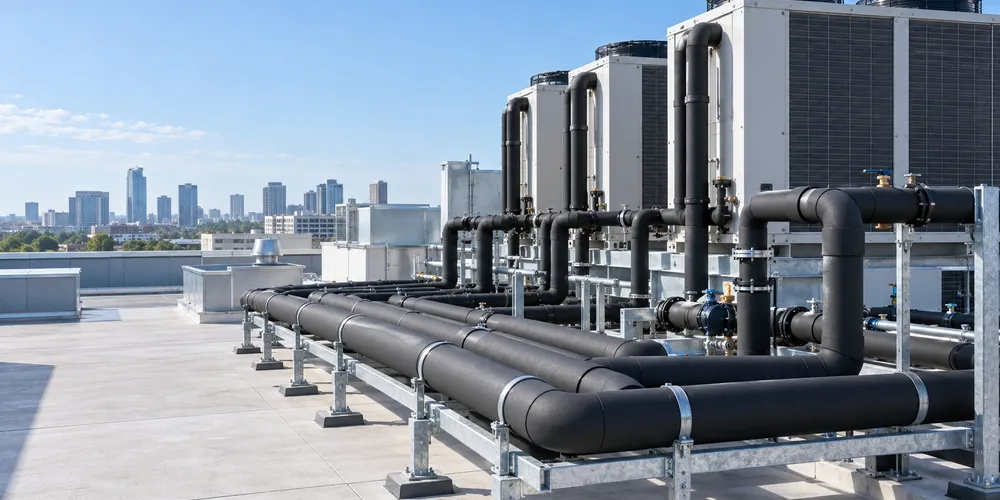
Outdoor pipework faces solar radiation, rain, wind, pollution, and mechanical damage. A black insulation surface exposed to direct sun may become much hotter than the reported air temperature. Armacell’s AF/ArmaFlex guidance requires UV protection for outdoor or UV-exposed applications.
Approved coatings or cladding can protect the insulation, but scratches, loose laps, and open end seals still need repair.
What Buyers Should Confirm Before Ordering
A useful quotation should identify the precise product rather than state only “rubber foam.” Ask the supplier for:
- Polymer type, product name, tube or sheet form, and thickness
- Minimum and maximum continuous service temperatures
- Any intermittent temperature limit and its permitted duration
- Thermal conductivity with the corresponding mean test temperature
- Water-vapour data for below-ambient service
- Fire test standard, classification, thickness, and mounting scope
- Adhesive, tape, coating, and jacket compatibility
- Outdoor protection requirements and installation instructions
The sample, data sheet, test report, and delivered goods should refer to the same grade.
Common Temperature Selection Mistakes
Several mistakes appear repeatedly in insulation enquiries:
- Treating a short temperature spike as a continuous rating
- Applying a tube rating to fully bonded sheets or duct lining
- Assuming all NBR/PVC or all EPDM products share one range
- Ignoring adhesive and protective-finish limits
- Using fluid temperature alone without checking the design envelope
- Believing a higher density automatically proves better heat resistance
Frequently Asked Questions
What Temperature Can Standard Elastomeric Foam Handle?
There is no single value. Many standard NBR/PVC products publish upper limits near 105°C or 110°C, but the quoted grade’s data sheet controls.
Can Rubber Foam Be Used at 120 Degrees Celsius?
Some specialised or EPDM products are rated for 120°C or higher. Standard NBR/PVC products may not be. Confirm the written limit.
Is Rubber Foam Suitable for Steam Pipes?
Only when the full temperature and pressure conditions fall within the approved range. Many steam services are too hot for standard rubber foam.
Does Thicker Insulation Withstand More Heat?
No. Thickness changes heat flow, not the material’s declared service limit.
Can the Same Product Be Used Indoors and Outdoors?
Outdoor elastomeric insulation usually needs approved UV and weather protection, sealed joints, and periodic inspection.
Final Advice for Temperature Selection
Choose elastomeric insulation from the entire operating envelope, not from one attractive maximum-temperature figure. Continuous temperature, brief peaks, low-temperature flexibility, condensation risk, adhesive limits, UV exposure, and fire evidence all affect the decision.
When the specification is unclear, ask for the exact data sheet before ordering. That simple check helps prevent premature hardening, open joints, condensation, and an insulation system that does not match the pipe it was purchased to protect.