On this page
- Why Humidity Challenges Pipe Insulation
- How Elastomeric Foam Handles Moisture
- Pipe Insulation to Stop Condensation
- Where Rubber Pipe Insulation Fits
- Common Moisture-Control Weak Points
- Installing Elastomeric Foam Insulation Pipe
- Comparing Humid-Area Insulation Options
- Buyer Checklist for Humid Projects
- Frequently Asked Questions
- Final Answer for Humid Environments
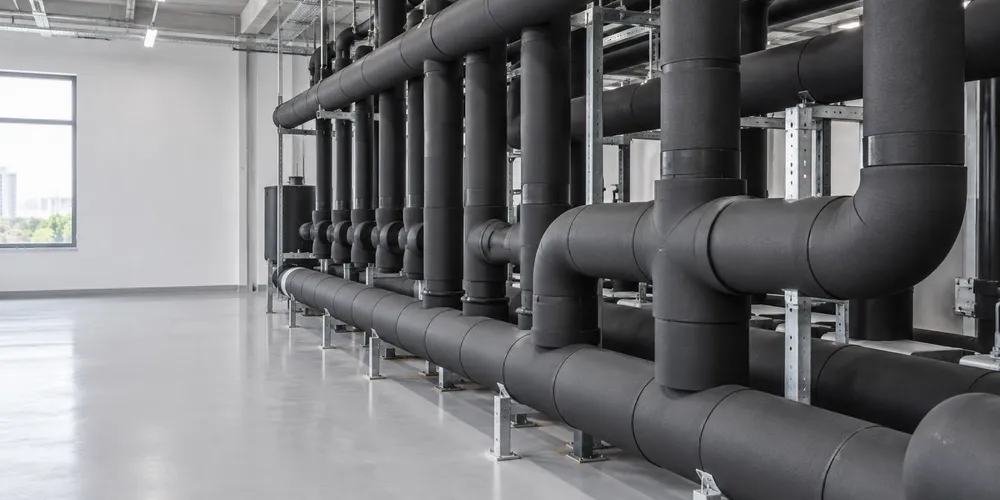
Elastomeric foam insulation can be suitable for humid environments because its flexible closed-cell structure limits water-vapor movement and resists liquid-water uptake better than many open fibrous structures. It is commonly considered for chilled-water, refrigeration, HVAC, and compatible industrial pipe systems.
The material alone does not guarantee a dry installation. Condensation control still depends on pipe temperature, ambient humidity, insulation thickness, sealed joints, supports, penetrations, and surface protection. This guide explains what buyers and contractors should verify before using rubber foam in a damp or high-humidity location.
Why Humidity Challenges Pipe Insulation
Humid air contains water vapor. When that air reaches a surface below its dew-point temperature, liquid water can form. Cold pipes, valves, and equipment are therefore vulnerable when they operate in warm, moist surroundings.
Moisture Can Increase Heat Transfer
Water conducts heat more readily than still air trapped in many insulation structures. If moisture enters an insulation system, thermal performance can decline while the material is wet. Persistent wetting may also affect nearby finishes, supports, and metal surfaces.
Condensation Can Damage Other Materials
Dripping water can stain ceilings, damage finishes, create slip hazards, and wet surrounding construction. Moisture reaching the pipe may also contribute to corrosion under insulation. A cold-service design needs thermal control and an effective path for limiting vapor entry.
High Humidity Raises the Dew Point
The dew point rises as air contains more moisture. An insulation thickness that stays dry in a controlled office may be inadequate in a humid plant room, coastal building, laundry area, food-processing space, or service corridor with outdoor-air infiltration.
How Elastomeric Foam Handles Moisture
Elastomeric foam insulation is a flexible material commonly supplied as tubes, sheets, and rolls. Many products use nitrile rubber and PVC-based formulations, although exact composition and performance vary by manufacturer and grade.
Closed Cells Restrict Vapor Paths
Closed cell pipe insulation contains small cells that are largely separated from one another. This structure restricts the continuous paths available for water vapor. It can therefore support vapor control without depending only on a separate outer membrane.
The Surface Is Not the Whole System
Even a moisture-resistant foam can fail at an open seam, cut edge, puncture, termination, or crushed support. The installed layer must remain continuous across straight pipe runs, elbows, tees, valves, hangers, and equipment connections.
Water Resistance Is Not Waterproofing
Elastomeric foam should not be described as universally waterproof. Product behavior depends on the test method, thickness, surface condition, exposure, and installation. Outdoor rain, washdown, flooding, or standing water may require jackets, coatings, drainage, or another protective system.
Pipe Insulation to Stop Condensation
Pipe insulation to stop condensation works by keeping the outer insulation surface above the local dew point while limiting water vapor from reaching the cold pipe. Both functions must remain effective throughout the system.
Thickness Must Match the Conditions
Required thickness depends on fluid temperature, pipe size and material, ambient temperature, relative humidity, air movement, insulation conductivity, surface emissivity, and the chosen safety margin. There is no universal thickness that prevents condensation in every climate.
Conductivity Data Needs Context
Thermal conductivity changes with mean temperature and may differ between grades. Buyers should compare values reported with consistent units, test methods, temperatures, and specimen conditions. A low number without test context is not a complete design basis.
Air Movement Can Change the Result
Air movement affects heat transfer at the insulation surface. Mechanical ventilation, open doors, fans, and outdoor exposure can change local conditions. The designer should use realistic operating conditions rather than relying on a general room average.
Where Rubber Pipe Insulation Fits
Rubber pipe insulation is often used where below-ambient services pass through damp or humid areas. Suitability must still be confirmed against the exact product’s service-temperature range, fire performance, exposure limits, and project requirements.
Chilled-Water and HVAC Lines
Chilled-water supply and return pipes may both need insulation depending on operating temperatures and site conditions. Flexible tubes can reduce the number of joints along straight sections, while sheets can cover large pipes and irregular components.
Refrigeration Pipework
Refrigeration services can operate at lower temperatures than typical chilled-water systems. The foam grade, adhesive, thickness, and joint system must suit those temperatures. Low-temperature claims should be checked against the supplier’s declared data.
Humid Industrial Areas
Food-processing areas, utility rooms, coastal plants, and other humid industrial locations may benefit from closed-cell insulation. Cleaning methods, chemicals, UV exposure, mechanical impact, and local hygiene rules can require added protection.
Common Moisture-Control Weak Points
Most moisture problems appear at details rather than in the middle of an undamaged pipe section. Installation planning should therefore give fittings and interfaces the same attention as straight runs.
Open Seams and Butt Joints
Longitudinal seams and butt joints need full contact and the approved adhesive or closure method. Tape should not hide a gap below it. A small opening can expose a cold surface and become a local condensation point.
Elbows, Valves, and Flanges
Complex components require accurate cutting and fitting. Pieces should meet without exposed metal or channels for humid air. Serviceable components may need removable covers that can be restored after maintenance.
Pipe Supports and Hangers
Supports can compress insulation or bridge cold metal to the surrounding structure. Compatible load-bearing inserts, shields, and vapor seals may be required. The correct detail depends on load, pipe size, temperature, and movement.
Outdoor and Exposed Surfaces
Sunlight, rain, impact, and maintenance traffic can damage exposed foam. A compatible coating, jacket, or cladding system may be necessary. Protection should not crush the insulation or leave unsealed penetrations.
Installing Elastomeric Foam Insulation Pipe
Elastomeric foam insulation pipe should be installed on clean, dry surfaces using accessories approved for the selected system. Moisture, oil, dust, rust, and incompatible coatings can reduce adhesive performance or become trapped below the insulation.
Use the Correct Tube Size
Stretching a small tube over a larger pipe reduces wall thickness and stresses the seam. Heavy compression also changes the installed geometry. Installers should select the correct internal diameter and avoid pulling the foam beyond the supplier’s instructions.
Seal Work as Installation Progresses
Joints should be completed as work proceeds. Leaving long sections open increases the chance of contamination, misalignment, or moisture entry. Cut edges and terminations need the specified closure rather than an improvised repair.
Inspect Before Concealment
The installation should be checked before ceilings, jackets, labels, or equipment panels block access. Inspectors should look for open seams, exposed metal, damaged surfaces, compressed supports, loose closures, and incomplete penetrations.
Comparing Humid-Area Insulation Options
Closed-cell elastomeric foam has an inherent structure that can resist vapor movement. Fibrous insulation systems can also work on cold services, but they often rely more heavily on a separate, continuous vapor-retarder and protective facing. Neither approach succeeds when joints and penetrations are incomplete.
Compare Complete Assemblies
Buyers should compare the insulation, vapor-control method, supports, adhesive, facing, jacket, and installation requirements as one system. Comparing only material density or purchase price can hide differences in labor, protection, and maintenance needs.
Buyer Checklist for Humid Projects
Before ordering, provide the supplier with:
- Pipe material, outside diameter, and total length.
- Fluid and pipe operating temperatures.
- Ambient temperature and relative humidity.
- Required thickness or calculation criteria.
- Indoor, outdoor, concealed, or exposed location.
- Quantities of elbows, tees, valves, and supports.
- Coating, jacket, adhesive, and closure requirements.
- Required test reports and destination-market documents.
Frequently Asked Questions
Is Elastomeric Foam Good for Humidity?
Yes, it can be suitable when the grade, thickness, vapor performance, and installation details match the actual temperature and humidity conditions.
Does Closed-Cell Foam Absorb Water?
Closed-cell foam generally limits liquid-water uptake and vapor movement, but performance varies by product and test method. Damaged or open joints can still admit moisture.
Can Rubber Insulation Prevent Mold?
Insulation can reduce surface condensation when correctly designed, which helps limit persistent wetting. It cannot guarantee that mold will never occur in the surrounding building or on contaminated surfaces.
Is a Separate Vapor Barrier Required?
The answer depends on the product, assembly, environment, and specification. Some elastomeric systems rely on their closed-cell structure, while demanding or exposed locations may require additional protection.
Can It Be Used Outdoors?
Some products can be used outdoors with compatible UV and weather protection. Buyers should confirm the approved coating or jacket system and maintenance requirements.
What Evidence Should Importers Request?
Importers should request product-specific thermal, vapor, dimensional, temperature, and fire-performance data. Kingsenda can help match available formats to an inquiry, while final approval remains with the project designer and local authority.
Final Answer for Humid Environments
Elastomeric foam insulation is often a practical choice for humid HVAC, chilled-water, refrigeration, and compatible industrial pipe systems. Its closed-cell structure supports moisture resistance, but reliable performance depends on calculated thickness, sealed joints, protected supports, compatible accessories, and inspection. Buyers should evaluate the complete assembly rather than relying on a broad waterproof claim.