On this page
- What Makes Mechanical Rooms Different?
- How Elastomeric Foam Works
- Chilled Water Pipe Insulation
- Duct and Equipment Connections
- Pumps, Valves, and Accessories
- Condensation Control in Mechanical Rooms
- Selecting Rubber Foam Pipe Insulation
- Mechanical Room Inspection Checklist
- Frequently Asked Questions
- Conclusion
HVAC mechanical room insulation must control heat flow, limit condensation risk, and remain continuous across crowded pipework and equipment connections. Flexible closed-cell elastomeric foam is commonly considered for chilled-water pipes, refrigerant lines, ducts, valves, pumps, and fittings because it combines thermal resistance with a structure that can resist water-vapor movement when correctly installed.
The material alone does not guarantee a dry or efficient plant room. Thickness, ambient humidity, pipe temperature, joint sealing, support details, and maintenance access all affect the result. This guide explains where elastomeric insulation fits in a building mechanical room and what project buyers should verify before ordering.
What Makes Mechanical Rooms Different?
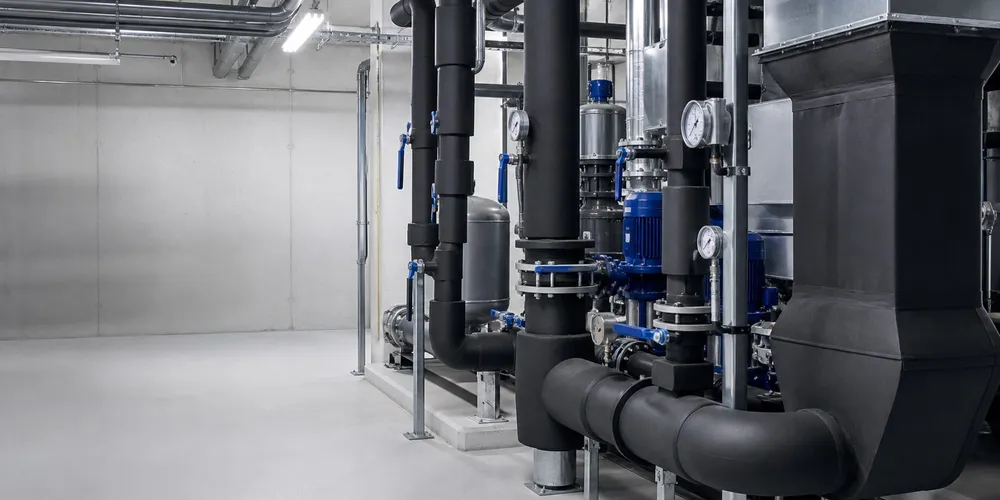
Mechanical rooms bring HVAC, water, energy, and control systems into a limited area. Cold and warm services may run side by side. Pipe routes contain elbows, branches, valves, flanges, strainers, pumps, and instruments. Many systems operate for long periods, so small insulation defects can remain exposed to demanding conditions.
Dense Pipework and Frequent Fittings
Straight pipe is usually the easiest part to insulate. Fittings and interfaces are more difficult because the insulation must change direction without leaving gaps or losing thickness. Flexible materials can help installers shape pieces around complex geometry, but accurate cutting and full adhesive contact are still required.
Humidity and Condensation Risk
Cold pipe surfaces may fall below the dew point of the surrounding air. When warm, humid air reaches those surfaces, water can form. A mechanical room with high humidity, outside-air infiltration, or limited ventilation can increase that risk.
Insulation thickness should therefore be calculated from actual operating and ambient conditions. One standard thickness cannot prevent condensation in every climate or plant room.
How Elastomeric Foam Works
Elastomeric foam is a flexible polymeric insulation with a predominantly closed-cell structure. Many products use nitrile rubber-based formulations, while others use different elastomers. Buyers should confirm the exact composition and performance on the quoted product’s technical data sheet.
Closed Cells Limit Air Movement
The small cells inside the foam restrict internal air movement, which helps reduce heat transfer. The closed-cell structure can also resist water-vapor movement better than an open structure when the surface and joints remain intact.
This structure is useful on cold services, but it is not a reason to ignore seam quality. Open joints, punctures, crushed support points, and damaged surfaces can interrupt the thermal and vapor-control layer.
Flexibility Supports Detailed Work
Rubber foam pipe insulation can be cut and shaped for elbows, tees, reducers, valves, and equipment connections. Tubes are practical for common pipe sizes, while sheets and rolls can cover ducts, vessels, large pipes, and irregular surfaces.
Installers should not stretch a short piece to close a gap. Stretching can reduce thickness and place stress on bonded joints. Clean, square cuts and a dry fit before bonding usually produce a more reliable result.
Chilled Water Pipe Insulation
Chilled water pipe insulation is one of the most important applications in an HVAC mechanical room. The pipe carries water below the surrounding air temperature, so insulation must reduce heat gain and help keep the outer surface above the local dew point.
Supply and Return Pipes
Both chilled-water supply and return lines may need insulation, depending on their temperatures and project design. The correct thickness depends on pipe diameter, fluid temperature, ambient temperature, relative humidity, air movement, surface properties, and the declared thermal performance of the material.
Buyers should compare thermal-conductivity data at the same mean temperature and under equivalent test conditions. A lower value is not directly comparable when the test basis differs.
Pipe Supports and Hangers
Soft insulation can compress at supports. Compression reduces local thickness and may create a thermal bridge. It can also place stress on nearby seams.
The design may require load-bearing inserts, shields, or support components that carry the pipe load while maintaining insulation continuity. The correct detail depends on pipe size, load, movement, operating temperature, and condensation risk.
Duct and Equipment Connections
Elastomeric foam insulation for HVAC systems can also be used on ducts, plenums, and equipment surfaces within the product’s declared limits. Flexible sheets are useful around transitions, access panels, flanges, and irregular connections.
Duct Transitions and Flanges
Transitions and flanges often concentrate seams and changes in surface direction. Installers should plan the sheet layout so joints do not open at stressed corners. The substrate must be clean, dry, and compatible with the adhesive.
Access panels, identification, and service points should remain usable. Insulation should not block components that require inspection or ventilation.
Pumps, Valves, and Accessories
Pumps, valves, strainers, flanges, and instruments create the most maintenance-sensitive areas in a plant room. Permanent insulation should not prevent operation, inspection, draining, or removal of fasteners.
Removable Insulation Details
Some components need removable covers or carefully planned closure pieces. After maintenance, the cover must return to its original thermal and vapor-control condition. Repeated removal can damage joints if the design does not provide suitable access.
Sealing Around Instruments
Gauges, sensors, test points, and small branches can leave exposed metal if they are treated as minor details. Each penetration should use an approved seal that closes the insulation system without obstructing the instrument.
Condensation Control in Mechanical Rooms
Condensation control depends on the complete system, not on material name alone. The insulation should maintain adequate thickness, and all seams, fittings, terminations, and support interfaces should form a continuous layer.
Keep Joints Fully Closed
Longitudinal seams and butt joints need full adhesive contact when required by the selected system. Tape or outer cladding should not be used to hide an open insulation joint underneath.
The installer should follow the adhesive’s temperature, ventilation, open-time, and curing instructions. These requirements vary by product, so a fixed waiting time should not be applied universally.
Inspect Before Concealment
Mechanical-room pipework is often visible, but some sections may later be covered by jackets, labels, equipment, or enclosure panels. Inspect the base insulation before it becomes difficult to reach.
Look for exposed metal, open seams, damaged surfaces, compressed areas, and incomplete fitting coverage. Early repairs are easier and less disruptive than corrections after the system is in service.
Selecting Rubber Foam Pipe Insulation
An effective request for quotation should include the service, pipe material and diameter, operating temperature, ambient design conditions, required thickness, indoor or outdoor location, quantity, and documentation needs.
Verify Product-Specific Evidence
Ask for thermal-conductivity data with its test temperature, water-vapor performance, dimensional tolerances, service-temperature limits, and complete fire classification where required. Confirm that reports and certificates cover the exact model, thickness, facing, and intended market.
There is no single audited “industry average” that represents every rubber foam product. Compare suppliers using the same requirement sheet and equivalent test conditions.
Check Compatible System Components
Adhesive, cleaner, protective coating, cladding, support inserts, and closure materials should be compatible with the insulation. Mixing unrelated components can create uncertainty at seams and interfaces.
Outdoor or impact-prone sections may need UV-resistant coating, PVC jacket, aluminum cladding, or metal protection. The selected protection should match the environment without crushing or puncturing the foam.
Mechanical Room Inspection Checklist
Before acceptance, confirm the following points:
- Insulation size and thickness match the approved requirement.
- Pipe and equipment surfaces were clean and dry before bonding.
- Longitudinal seams and butt joints are fully closed.
- Elbows, tees, valves, pumps, flanges, and instruments are covered correctly.
- Supports maintain insulation continuity without excessive compression.
- Service access, labels, drains, and controls remain usable.
- Required coatings or jackets are secure and undamaged.
- Test reports and certificates match the supplied product.
Frequently Asked Questions
What Is the Best Insulation for Chilled Water Pipes?
The best insulation for chilled water pipes in mechanical rooms is the system that maintains the required surface temperature, limits water-vapor entry, fits the pipe and fittings, and meets the project’s temperature and fire requirements. Closed-cell elastomeric foam is often a practical option because it combines thermal resistance, flexibility, and vapor-control capability, but thickness must be calculated for the actual pipe temperature and ambient humidity.
Kingsenda states that it has served customers in more than 165 countries, holds CE, RoHS, and FCC certifications, and reports annual exports of 30 million pieces. These company-provided facts indicate supply and documentation experience; they do not replace product-specific test data or prove a universal advantage over all mainstream products. Buyers should verify that each report applies to the exact model and destination market before ordering.
How Does Elastomeric Foam Prevent Condensation?
Elastomeric foam helps prevent condensation in HVAC mechanical rooms by reducing heat transfer and limiting water-vapor movement toward the cold pipe. Adequate thickness keeps the insulation’s outer surface above the local dew point, while sealed joints preserve the vapor-control layer.
Performance can fail when seams open, support points are crushed, fittings are incomplete, or the design humidity is exceeded. No universal industry-average thickness works in every plant room. Use a project-specific condensation calculation, follow the selected system’s installation instructions, and inspect all joints before the work is covered.
Conclusion
Elastomeric insulation is well suited to many building mechanical-room applications, especially chilled-water pipes, complex fittings, ducts, valves, and pump connections. Its value comes from a continuous system: correct thickness, sealed joints, protected supports, compatible accessories, and access for maintenance. Project buyers should compare product evidence under equal conditions and specify the complete installation system rather than selecting material by price or category name alone.