On this page
- Why HVAC Systems Need Insulation
- What Is Glass Wool Insulation?
- Glass Wool Duct Insulation Uses
- Fiberglass Duct Insulation and Sound
- Glass Wool Pipe Insulation in HVAC
- Moisture Control for HVAC Insulation
- Fire Performance and Approval
- Installing Glass Wool Duct Wrap
- Buyer Checklist for HVAC Projects
- Frequently Asked Questions
- Final Guidance for HVAC Buyers
Glass wool is widely used as HVAC duct insulation because its porous fiber structure can slow heat transfer and absorb sound while adding relatively little weight to ductwork. It is supplied as blankets, boards, wraps, and engineered duct products for different parts of an air-conditioning system.
The material cannot solve every HVAC problem by itself. Thermal performance, condensation control, acoustic results, fire approval, and durability depend on thickness, density, facing, compression, joints, supports, and installation. This guide explains how contractors, designers, and project buyers should evaluate the complete system.
Why HVAC Systems Need Insulation
HVAC systems distribute conditioned air and water through long networks of ducts and pipes. Insulation limits unwanted heat transfer between the system and surrounding spaces. It can also reduce surface condensation and help control equipment or airflow noise.
Heat Gain and Heat Loss
Supply air can warm or cool as it moves through an uninsulated duct. The effect depends on duct area, temperature difference, airflow, route length, leakage, and surrounding conditions. Correct insulation reduces heat flow, but the expected energy result must be calculated for the actual system.
Condensation on Cold Surfaces
Condensation forms when a duct or pipe surface falls below the dew-point temperature of nearby air. Insulation can raise the outer surface temperature, while a continuous vapor-control layer limits humid air from reaching colder layers. Both functions are needed in below-ambient service.
Noise From Air and Equipment
Fans, dampers, airflow, and equipment can create noise inside duct systems and mechanical rooms. Fibrous insulation can absorb part of this sound energy. Final performance still depends on the full construction, including duct gauge, lining, enclosure, connections, and installation quality.
What Is Glass Wool Insulation?
Glass wool is an inorganic fibrous material made from a glass-based melt that is formed into fine fibers. The fiber network holds many small air spaces, which resist heat flow and absorb sound. Exact raw materials, binders, facings, and performance vary by product.
Common HVAC Product Forms
Glass wool blankets and rolls fit broad surfaces and curved sections. Boards suit rectangular ducts, equipment casings, and acoustic enclosures. Preformed pipe sections fit compatible round services. Engineered duct products may combine structure, insulation, and facing in one tested assembly.
Density and Thickness Serve Different Roles
Thickness has a strong effect on thermal resistance. Density influences handling, recovery, acoustic response, and mechanical behavior, but a higher density does not automatically provide better thermal performance. Buyers should compare declared data for the exact product and thickness.
Glass Wool Duct Insulation Uses
Glass wool duct insulation is commonly installed outside metal ducts or incorporated into approved internal lining and duct-board systems. The location changes the material’s exposure, facing needs, acoustic role, and cleaning requirements.
External HVAC Duct Insulation
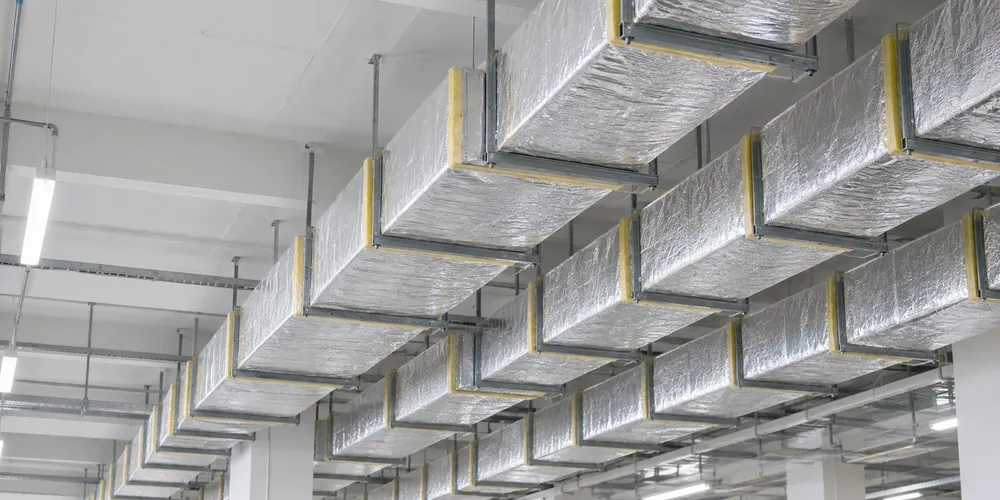
External blankets or boards can reduce heat transfer without placing fibers in the airstream. The system may include aluminum foil or another facing for vapor control and surface protection. Joints, hangers, flanges, and access doors require continuous detailing.
Internal Duct Lining
Internal lining can provide thermal and acoustic benefits, but the lining product must be intended for the application. Air velocity, erosion resistance, surface treatment, cleaning method, hygiene requirements, and fire approval should be verified for the complete duct assembly.
Glass Wool Duct Wrap
Glass wool duct wrap is a flexible blanket used around rectangular or round ductwork. It should be fitted without excessive compression and secured using the specified method. Facing laps and penetrations need compatible sealing where the facing forms part of the vapor-control layer.
Fiberglass Duct Insulation and Sound
Fiberglass duct insulation can help reduce noise because the interconnected fiber structure dissipates part of the sound energy entering the material. It is often used around air-handling equipment, duct transitions, and plant-room enclosures where thermal and acoustic needs overlap.
Sound Absorption Is Assembly-Specific
One material value cannot describe every finished duct. Acoustic performance depends on insulation thickness, density, exposed or covered surface, perforated facings, cavity depth, duct dimensions, airflow, and frequency. Buyers should request test data that resembles the proposed construction.
Avoid Blocking Required Airflow
Insulation should not restrict designed duct area, cover sensors, obstruct dampers, or interfere with access panels. Internal products should be installed flush and secure so edges do not disturb airflow or become damaged during maintenance.
Glass Wool Pipe Insulation in HVAC
Glass wool pipe insulation is used on compatible heating, cooling, and service pipes when the product and protective system match the temperature and moisture conditions. Preformed sections can reduce cutting and provide consistent coverage along straight pipe runs.
Cold Pipes Need Vapor Control
On chilled-water or other cold services, the insulation system needs a continuous vapor retarder. Open joints, damaged facings, crushed supports, and unsealed terminations can allow moisture to reach colder layers and the pipe surface.
Hot Pipes Have Different Priorities
Heating-water and other warm services may place more emphasis on heat-loss control and safe surface temperature. The glass wool grade, binder, facing, jacket, and accessories must suit the operating temperature and exposure.
Moisture Control for HVAC Insulation
Glass wool is a fibrous material and should remain dry in storage, installation, and service. A suitable facing or vapor-retarder system can limit water-vapor movement, but its position and continuity must follow the climate and assembly design.
Keep Facings Continuous
Foil and other facings need sealed laps, corners, punctures, and terminations. Hangers and access doors are common weak points. A reflective appearance alone does not prove that the vapor-control path is complete.
Protect Outdoor Ductwork
Outdoor systems may require weatherproof cladding, sealed joints, drainage, and UV-resistant materials. The protective system should shed water and withstand wind or maintenance loads without compressing the insulation.
Fire Performance and Approval
Glass fibers are inorganic, but finished HVAC insulation includes binders, facings, adhesives, tapes, and other components. Fire performance should be verified for the exact product or assembly, not inferred from the fiber alone.
Check the Test Configuration
A useful report identifies the standard, edition, specimen thickness, density, facing, substrate, mounting method, classification, and tested product. Project acceptance follows local rules, contract documents, and the authority having jurisdiction.
Do Not Mix Unverified Components
Changing a facing, tape, adhesive, or installation method can create a different assembly from the tested construction. Substitutions should be reviewed by the designer and approval route before installation.
Installing Glass Wool Duct Wrap
Good installation preserves thickness, closes gaps, and protects facings. Workers should follow the product safety information and site requirements when cutting and handling fibrous insulation.
Measure Before Cutting
Pieces should fit the duct dimensions and allow the specified overlap. Planning cuts around branches, transitions, dampers, and access doors reduces small patches and uncontrolled joints.
Avoid Excessive Compression
Pulling wrap too tightly over corners, flanges, or hangers reduces installed thickness. Compression should be limited to the system’s approved details. Voids should not be filled with loosely packed scraps as a substitute for a proper piece.
Inspect Before Concealment
Inspect thickness, coverage, facing direction, joints, penetrations, hangers, access points, and damaged areas before ceilings or enclosures hide the work. Photographs can document concealed sections for later review.
Buyer Checklist for HVAC Projects
Before asking for a quotation, provide:
- Duct or pipe dimensions and total quantities.
- Supply, return, exhaust, or water-service temperatures.
- Ambient temperature and relative humidity.
- Required insulation thickness or thermal target.
- Internal, external, indoor, outdoor, or concealed location.
- Facing, jacket, vapor-control, and acoustic requirements.
- Fire and acoustic documents required for approval.
- Packaging, labeling, delivery, and installation needs.
Frequently Asked Questions
Is Glass Wool Suitable for HVAC Ducts?
Yes, glass wool is commonly used on HVAC ducts when the product form, thickness, facing, acoustic role, fire evidence, and installation method match the project.
Does Glass Wool Reduce Duct Noise?
It can absorb sound and support noise control, but the result depends on the complete duct construction, insulation thickness, facing, airflow, and frequency range.
Is Foil Facing Always Required?
No single facing suits every system. Cold ducts often need vapor control, while indoor warm-air or acoustic applications may use different surfaces. The designer should specify the facing and its sealed continuity.
Can Glass Wool Insulate Chilled-Water Pipes?
Yes, suitable preformed glass wool sections can insulate chilled-water pipes when a continuous vapor-retarder and correctly detailed supports protect the system from moisture.
How Is HVAC Insulation Thickness Selected?
Thickness depends on temperature, humidity, duct or pipe size, material conductivity, condensation risk, energy requirements, and local codes. A single thickness does not fit every system.
What Should Importers Request?
Importers should request product-specific thermal, dimensional, acoustic, moisture, and fire-performance data. Kingsenda can help match available glass wool formats to an inquiry, while final approval remains with the project designer and local authority.
Final Guidance for HVAC Buyers
Glass wool HVAC duct insulation can provide thermal control, sound absorption, low weight, and practical coverage across ducts, pipes, and equipment. Reliable performance comes from selecting the correct format, preserving thickness, controlling moisture, sealing facings, and verifying evidence for the exact assembly. Buyers should compare complete systems rather than choosing by price or density alone.