On this page
- What Is Glass Wool Insulation?
- Building Thermal Insulation Applications
- Glass Wool Insulation for HVAC Systems
- Glass Wool Pipe Insulation for Industrial Applications
- Industrial Equipment and Storage Tanks
- Acoustic Insulation Beyond HVAC
- How to Select the Right Product Form
- Installation Details That Protect Performance
- Frequently Asked Questions
- Final Selection Advice
- Editorial Sources
Glass wool insulation is used wherever a project needs to slow heat flow, absorb sound, or improve the thermal performance of a building or mechanical system. Common applications include external walls, roofs, HVAC ducts, hot- and cold-water pipes, industrial equipment, storage tanks, and acoustic linings.
That broad application range does not mean one product fits every location. Rolls, boards, blankets, and preformed pipe sections differ in density, facing, thickness, temperature limit, compressive strength, and reaction-to-fire classification. A reliable specification begins with the operating conditions, not with a general material name.
What Is Glass Wool Insulation?
Glass wool is a mineral-fibre insulation made by melting glass-based raw materials and forming the molten material into fine fibres. A binder holds the fibres together so that manufacturers can produce rolls, batts, boards, blankets, and pipe sections. Air trapped within the fibre network provides much of the material’s resistance to heat flow.
Why the Fibre Structure Matters
The open, tangled fibre structure serves two useful purposes. It restricts air movement within the insulation, which supports thermal performance, and it dissipates sound energy as air moves through the pores. This is why the same product family often appears in both thermal and acoustic specifications.
Building Thermal Insulation Applications
In buildings, glass wool is most often installed in framed cavities or layered assemblies. It can be used in residential, commercial, public, and industrial buildings, but the required product depends on the wall or roof design, climate, moisture conditions, and local code.
Glass Wool Insulation in External Walls
Wall systems need continuous coverage around studs, rails, fasteners, and service penetrations. Glass wool batts or boards can fill framed cavities. The insulation should fit closely without being folded into corners or leaving exposed gaps.
Fire claims need careful reading. Some unfaced glass mineral wool products achieve high non-combustibility classifications, but facings, adhesives, and complete wall assemblies can have different results. Buyers should check the classification report for the exact product construction and market rather than assuming that every glass wool product has the same rating.
Glass Wool Insulation Board for Roofs
A Glass Wool Insulation Board or roll can reduce heat transfer through pitched roofs, suspended ceilings, and selected metal-roof assemblies. In steel buildings, blankets are often installed with profiled metal sheets as part of a designed roof system. Besides limiting heat flow, the fibrous layer can reduce reverberation from rain or mechanical activity.
Glass wool is not a waterproof layer or a walking surface. Vapour control, weatherproofing, fasteners, and compression at supports belong to the roof-system design.
Glass Wool Insulation for HVAC Systems
Glass Wool Insulation for HVAC Systems is used around air ducts, plenums, mechanical equipment, and some pipe services. It helps limit unwanted heat gain or loss while its porous structure can reduce noise from fans, airflow, and adjacent rooms.
External Duct Wrap and Duct Board
Flexible wraps suit the outside of rectangular or circular metal ducts. Rigid or semi-rigid boards are used where the design needs a more stable surface or where the insulation becomes part of a fabricated duct solution. Foil-faced products may provide vapour-control and protective functions when joints are sealed according to the system instructions.
Thickness should reflect duct temperature, ambient conditions, humidity, and the permitted heat gain or loss. On cold ducts, an open facing joint can admit humid air and cause condensation.
Acoustic Control in Air Distribution Systems
Glass wool can absorb sound inside or around duct systems. This helps control fan noise, cross-talk, and breakout noise, but the acoustic result depends on product density, thickness, airflow surface, duct dimensions, and installation position. A generic claim such as “soundproof” says little about actual system performance.
Internal duct products must be designed for contact with the airstream. Ordinary building batts should not be substituted without supporting technical documentation.
Glass Wool Pipe Insulation for Industrial Applications
Preformed sections and high-density products make Glass Wool Pipe Insulation for Industrial Applications practical on process lines, steam services, hot-water systems, chilled-water pipes, and selected equipment. The insulation reduces heat flow between the pipe and its surroundings and can help keep outer surfaces at a safer temperature.
Hot Pipes and Process Lines
On hot services, check operating temperature, pipe diameter, heat-loss limit, surface temperature, thickness, jacketing, and exposure. The data sheet must confirm the service temperature of the exact product because binders and facings can have lower limits than the glass fibres.
This distinction is important when a project mentions a single temperature such as 400°C. Some products may be designed for high-temperature work, while others are intended for lower-temperature building services. The data sheet and project calculation should decide suitability.
Cold Pipes and Condensation Control
Cold-water systems require more than thermal resistance. Glass wool pipe sections can be used when the design includes adequate thickness, a suitable vapour retarder, and sealed joints. Elbows, valves, supports, and terminations are common weak points.
Industrial Equipment and Storage Tanks
Glass wool boards and blankets can be fitted around boilers, heat exchangers, vessels, tanks, and other equipment where their product limits suit the service. Removable cladding or metal jacketing often protects the insulation from impact, weather, cleaning, and mechanical damage.
Equipment Geometry Changes the Detail
Flat boards suit large surfaces, while flexible blankets and purpose-made segments follow curves, nozzles, and supports. Oil, chemicals, washdown water, vibration, and outdoor exposure may require separate protective layers. The design should also preserve access to valves and inspection points.
Acoustic Insulation Beyond HVAC
The sound-absorbing character of glass wool supports applications in meeting rooms, studios, theatres, machinery enclosures, partitions, and suspended ceilings. It is usually concealed behind a perforated, fabric, board, or metal finish chosen for the room and its fire requirements.
Sound Absorption Is Not the Same as Sound Isolation
Sound absorption reduces reflections; sound isolation limits transmission between spaces. Glass wool can contribute to both, but isolation also depends on mass, airtightness, structural separation, and flanking paths.
How to Select the Right Product Form
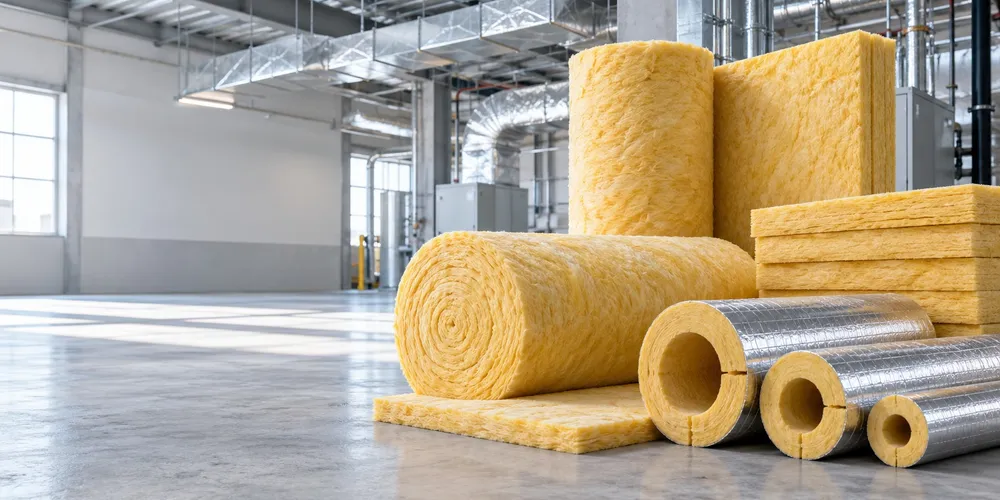
Product form should match the surface and its support. Rolls and blankets cover broad areas and irregular shapes. Boards provide a firmer surface. Preformed sections reduce cutting on straight pipe runs.
Check These Details Before Ordering
Buyers should request enough information to connect the quotation to the project specification:
- Product form, density, thickness, dimensions, and facing
- Declared thermal conductivity and the corresponding mean test temperature
- Maximum and minimum service temperatures for the complete product
- Reaction-to-fire classification, test standard, and report scope
- Water-vapour performance where condensation control is required
- Acoustic data when sound performance is a design objective
- Packaging, compression recovery, tolerances, and installation instructions
A sample and data sheet should refer to the grade being delivered. Similar-looking rolls can have different densities, facings, and intended uses.
Installation Details That Protect Performance
Good material cannot compensate for gaps, crushed sections, open vapour-barrier joints, or damaged cladding. Installers should cut neatly, fill cavities, stagger specified joints, and seal facings with compatible materials.
Inspection Should Focus on Weak Points
Corners, supports, elbows, valves, access doors, and penetrations deserve close inspection because thermal bridges and condensation paths often begin there.
Frequently Asked Questions
Is Glass Wool Insulation Suitable for Every Project?
No. Each product has limits for temperature, moisture, load, fire, hygiene, weather exposure, and maintenance conditions.
Can Glass Wool Be Used Around HVAC Ducts?
Yes. HVAC products include external wraps, boards, and specialised internal liners. Match the system to duct temperature, condensation risk, acoustic target, and local code.
Is Every Glass Wool Product Non-Combustible?
Do not assume so from the generic material name. Classification can depend on binder content, facing, thickness, mounting, and the test method. Confirm the report for the exact product and assembly.
Can Glass Wool Control Condensation on Cold Pipes?
Yes, when thickness is calculated correctly and a suitable vapour retarder remains continuous across joints and fittings.
Does Higher Density Always Mean Better Insulation?
No. Density influences handling, strength, acoustic behaviour, and thermal performance, but the relationship is not simply “higher is better.” Compare the declared thermal conductivity at the relevant temperature and select a density suited to the application.
What Should an Importer Confirm Before Purchase?
Match the quotation, sample, data sheet, test reports, dimensions, facing, packaging, and application. Kingsenda can help compare product forms, while final acceptance follows the project specification and local authority.
Final Selection Advice
Glass wool earns its place in many projects because it combines thermal insulation, useful sound absorption, light weight, and flexible product forms. Its real performance, however, comes from selecting the right grade and installing it as a complete system.
Before ordering, define the surface, operating temperature, ambient humidity, fire requirement, acoustic target, protective finish, and maintenance conditions. That short technical review is more valuable than choosing a roll or board by appearance or price alone.