On this page
- Why Use Glass Wool Roof Insulation?
- Where Is Glass Wool Used in Roofs?
- How Glass Wool Insulation Works
- Metal Roof Insulation and Moisture
- Glass Wool With Aluminium Foil
- Selecting a Metal Roof Insulation Blanket
- Installing Glass Wool Roof Insulation
- Buyer Checklist for Roof Projects
- Frequently Asked Questions
- Final Guidance for Metal Roof Projects
Glass wool roof insulation is used in metal and lightweight roof systems to slow heat transfer and absorb sound without adding excessive weight to the structure. It is commonly installed beneath profiled steel sheets, above an internal liner, or within a roof build-up designed by the project team.
The material cannot deliver the intended result by itself. Roof geometry, thickness, vapor control, compression, joints, fasteners, and weather protection all affect performance. This guide explains how contractors, importers, and project buyers can evaluate the complete roof insulation system.
Why Use Glass Wool Roof Insulation?
Glass wool contains a network of fine fibers that holds many small pockets of air. This structure resists heat flow and absorbs part of the sound energy that enters it. In a roof, these two functions can support indoor temperature control and reduce reflected noise.
Reducing Heat Flow Through the Roof
A metal roof can gain heat quickly under strong solar exposure and lose heat when outdoor temperatures fall. Insulation increases the thermal resistance of the roof assembly, which reduces the rate of heat transfer. The actual energy result depends on the whole building, climate, indoor conditions, air leakage, and roof design.
Controlling Rain Noise in Metal Buildings
Rain striking profiled metal sheets can create noticeable impact noise. A fibrous insulation layer can absorb sound within the roof build-up and reduce reverberation inside large spaces. The final acoustic result also depends on the metal sheet, liner, cavity depth, fasteners, and other layers.
Where Is Glass Wool Used in Roofs?
Glass wool is frequently specified for industrial buildings, warehouses, logistics centers, sports halls, exhibition buildings, and other structures with broad roof areas. The selected product must match the roof assembly rather than being chosen only by color or nominal thickness.
Insulation Under Profiled Metal Sheets
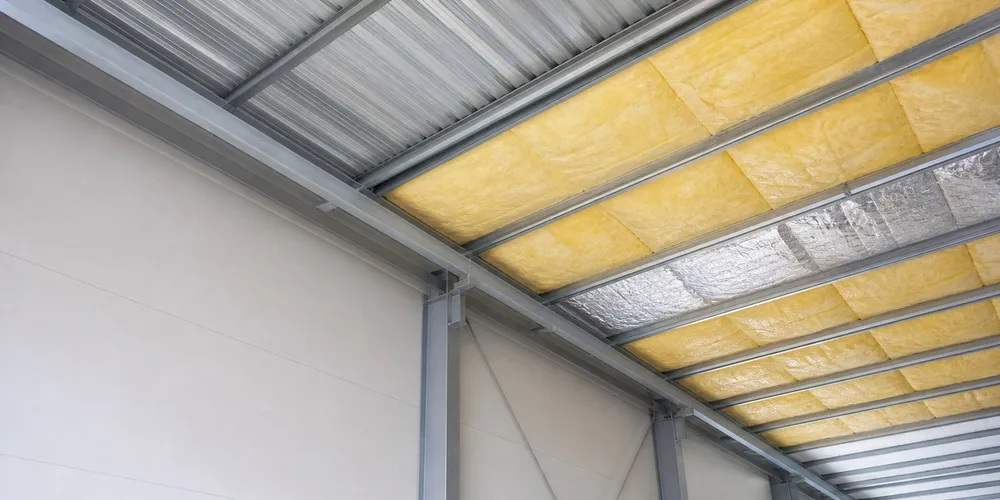
A metal roof insulation blanket can be placed beneath the external roof sheet and supported by purlins, mesh, or an internal liner according to the system design. Continuous coverage is important because gaps around purlins, penetrations, and roof edges can create weak thermal paths.
Lightweight and Long-Span Roofs
Low mass makes glass wool suitable for many lightweight steel structures. Even so, the structural designer must account for the complete roof load, including insulation, facings, liners, fixings, services, maintenance access, and any water that could enter through a failure.
How Glass Wool Insulation Works
Glass wool slows conduction and air movement within its fiber structure. It does not generate heating or cooling. It helps the designed roof separate indoor conditions from the outdoor environment, provided the material keeps its intended thickness and remains protected.
Thickness Must Remain Intact
Compressing a blanket reduces its installed thickness and can change its thermal resistance. Pulling a roll tightly over purlins or trapping it under fasteners may create uneven areas. Installers should follow the specified thickness, support method, and fixing details instead of forcing one blanket into every roof geometry.
Metal Roof Insulation and Moisture
Moisture control is a system-design issue. Warm humid air can move toward a colder roof layer, and condensation may form if the local surface temperature falls below the dew point. Rain leakage can create a separate wetting risk from outside.
Position the Vapor-Control Layer Correctly
The need and location of a vapor-control layer depend on climate, indoor humidity, roof temperature, ventilation, and assembly sequence. A layer installed on the wrong side can trap moisture. The project designer should define its position and continuity around laps, edges, penetrations, and fasteners.
Keep the Insulation Dry
Glass wool should be stored under cover and protected during installation. Wet material can lose useful thermal performance while moisture is present, add weight, damage finishes, and affect nearby metal or timber components. A roof leak must be repaired before damaged insulation is enclosed again.
Seal Joints and Penetrations
Open laps around skylights, ducts, cable routes, and roof edges can interrupt air and vapor control. These details should use compatible tapes, sealants, membranes, or closures specified for the assembly. A visually neat surface does not prove that hidden joints are sealed.
Glass Wool With Aluminium Foil
Glass wool insulation with aluminium foil combines a fibrous insulation core with a foil facing. Depending on the tested product and installation, the facing may provide a reflective surface, a cleaner exposed finish, or part of the vapor-control strategy.
Foil Is Part of an Assembly
Aluminium foil should not be treated as a universal waterproof layer. Its performance depends on foil thickness, reinforcement, lamination, laps, punctures, fixing method, and sealing. Buyers should request information for the supplied facing rather than assuming all foil-faced products are equal.
Protect the Facing During Installation
Tears, unsealed overlaps, and penetrations can reduce facing continuity. Installers should use compatible repair and jointing products. The foil surface should not remain exposed where the roof design requires mechanical protection or where maintenance work could damage it.
Selecting a Metal Roof Insulation Blanket
Selection should start with project conditions, not a generic product list. Roof type, purlin spacing, required thermal resistance, acoustic target, condensation analysis, facing direction, fire requirements, and installation sequence all influence the specification.
Confirm the Required Thermal Performance
Ask for declared thermal conductivity and thermal resistance data with the relevant test conditions. Values measured at different temperatures or for different specimens should not be compared as though they were identical. The design team should calculate the complete roof performance, including repeated metal components and thermal bridges.
Check Dimensions and Recovery
Buyers should confirm roll width, length, nominal thickness, thickness tolerance, density range, facing type, and packaging. Compressed rolls also need appropriate recovery after opening. The supplier’s storage and installation instructions should state how long the product needs to regain its intended form.
Verify Fire and Acoustic Evidence
Fire behavior belongs to the tested product and assembly. The report should identify the product, facing, thickness, substrate, mounting method, standard, and classification. Acoustic data should likewise state the tested construction because one material value cannot describe every roof system.
Installing Glass Wool Roof Insulation
Good installation keeps the layer continuous, dry, and close to its design thickness. Workers should use suitable personal protective equipment and follow the product safety information, site rules, and local requirements when cutting or handling fibrous insulation.
Plan the Roof Sequence
The team should coordinate insulation with roof sheets, liners, purlins, membranes, skylights, drains, ducts, and safety systems before work begins. This reduces unnecessary cutting and helps prevent later trades from puncturing a completed vapor-control layer.
Fit Without Gaps or Heavy Compression
Blankets should meet at joints without large voids. The material should fit around structural and service details without being crushed. Small offcuts should not be loosely packed into major gaps as a substitute for a planned detail.
Inspect Before Closing the Roof
Inspect coverage, blanket thickness, facing direction, joint seals, penetrations, damaged areas, and edge details before they become hidden. Photographic records can help project teams document areas that will no longer be accessible after the roof is closed.
Buyer Checklist for Roof Projects
Before requesting a quotation, provide the supplier with:
- Roof type, total area, slope, and purlin spacing.
- Required thickness or complete thermal target.
- Indoor temperature and humidity design conditions.
- Local outdoor climate and condensation criteria.
- Roll width, length, density, and facing requirements.
- Fire and acoustic documentation required for approval.
- Packaging, labeling, destination, and delivery schedule.
- Special details for skylights, edges, penetrations, and liners.
Frequently Asked Questions
Is Glass Wool Suitable for Metal Roofs?
Yes, glass wool is commonly used in metal roof systems when the product, thickness, support, moisture control, facing, and fire documentation match the designed assembly.
Does Glass Wool Reduce Rain Noise?
Glass wool can absorb sound and support rain-noise control, but the result depends on the complete roof construction. The roof sheet, cavity, liner, fixings, and blanket installation also matter.
Should Roof Glass Wool Have Foil?
Not every roof requires the same facing. Foil may support vapor control, reflectivity, or appearance, but its need and position depend on climate and roof design.
Can Glass Wool Touch Metal Roofing?
That detail must follow the specified roof system. Designers should consider drainage, ventilation, condensation, corrosion protection, compression, and the intended position of membranes and liners.
How Thick Should Roof Insulation Be?
There is no universal thickness. The design should consider climate, indoor conditions, energy requirements, thermal bridges, material conductivity, and condensation risk.
What Should Importers Confirm?
Importers should confirm dimensions, tolerances, facing, thermal data, fire evidence, acoustic evidence, packaging, and traceable product identification. Kingsenda can help match available glass wool formats to an inquiry, while the project designer and local authority retain final approval.
Final Guidance for Metal Roof Projects
Glass wool roof insulation can support thermal control, lower roof noise, and efficient coverage across large metal buildings. Reliable performance comes from the entire assembly: correct thickness, limited compression, dry storage, continuous joints, suitable vapor control, compatible facings, and careful inspection. Buyers should compare product-specific evidence and roof details rather than selecting a blanket by price alone.