On this page
In architectural insulation and HVAC (Heating, Ventilation, and Air Conditioning) engineering, glass wool and rubber plastic insulation materials are both frequently applied products. They are often compared side-by-side in practical projects to determine the optimal choice for different systems and operational environments.
What are the fundamental differences between glass wool and rubber plastic insulation? This article provides a systematic analysis across multiple dimensions—including material properties, thermal performance, fire resistance, and application scenarios—to help make your engineering material selection much clearer.
1. Material Properties and Structural Differences
The Characteristics of Glass Wool
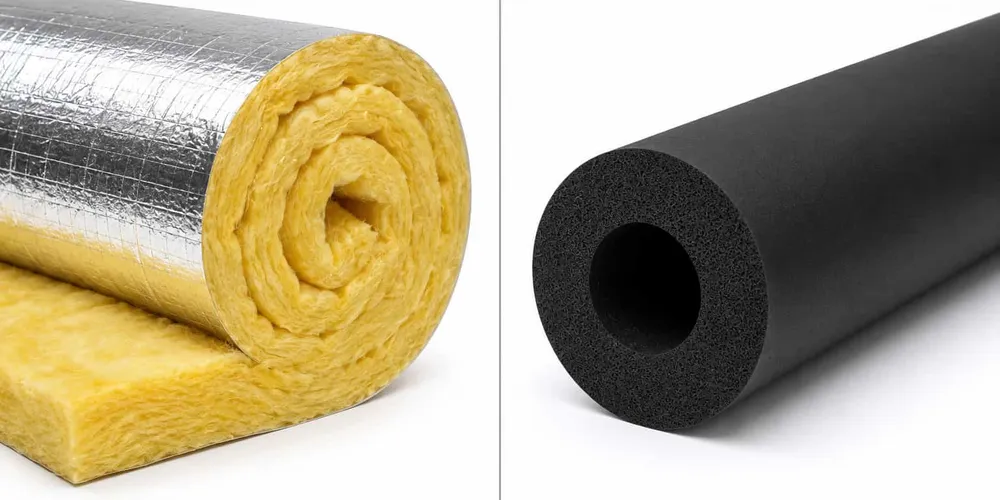
Glass wool is an inorganic fibrous insulation material. It is primarily manufactured from inorganic minerals such as quartz sand and limestone, which are melted at high temperatures and spun into fibers. Internally, it features a stable, porous system created by a vast network of randomly interwoven fine fibers. This specific structure grants glass wool excellent thermal insulation and acoustic absorption properties, making it widely adopted in building insulation and ventilation systems.
The Characteristics of Rubber Plastic Insulation
Rubber plastic insulation is an organic elastomeric insulation material. It is typically based on synthetic rubber and utilizes a foaming process to create a closed-cell structure. The internal air pores are completely independent of one another, resulting in high airtightness. This closed-cell structure makes rubber plastic exceptional in preventing condensation and offering high flexibility, making it particularly suitable for piping and complex, irregular installations.
2. Thermal Insulation Performance
In terms of thermal conductivity, both glass wool and rubber plastic meet stringent building energy-efficiency standards, but they achieve this through different mechanisms.
- Glass Wool: Reduces heat transfer by utilizing a massive amount of trapped, stagnant air. It is highly suitable for large-area surface installations.
- Rubber Plastic Insulation: Blocks heat transfer by relying on its closed-cell gas structure. It is highly suitable for pipe insulation.
Under the same thickness conditions, the difference in their thermal conductivity is minimal. However, in confined spaces or around irregular structures, the flexible nature of rubber plastic makes it easier to achieve stable insulation results.
3. Fire Resistance Comparison
Glass Wool Fire Performance
Glass wool itself is an inorganic, non-combustible material. It does not easily catch fire and will not support combustion. In a fire scenario, glass wool does not release substantial amounts of heat. Consequently, it is frequently applied in systems that have explicit, strict fire safety requirements.
Rubber Plastic Fire Performance
Because rubber plastic is an organic material, its fire resistance relies heavily on flame-retardant chemical additives. Through modification treatments, rubber plastic can achieve high flame-retardant ratings. However, under extreme high-temperature conditions, its fire-resistant stability is generally not on par with inorganic materials.
4. Condensation and Moisture Resistance
In practical engineering, the ability to prevent condensation is a critical factor when selecting an insulation material.
- Rubber Plastic Insulation: Its closed-cell structure makes it extremely difficult for water vapor to penetrate, giving it strong anti-condensation capabilities.
- Glass Wool: Features an open-cell porous structure, which typically requires it to be paired with a dedicated vapor/moisture barrier (such as aluminum foil).
In chilled water pipes and refrigerant piping systems, rubber plastic possesses a distinct advantage in preventing condensation. Glass wool, on the other hand, is better suited for dry environments or areas where moisture control can be strictly managed.
5. Installation Performance and Suitability
Glass Wool Installation Features
Glass wool is ideal for large-area coverage. Its common formats include blankets (rolls) and boards, which offer high installation efficiency. It is perfectly suited for HVAC ducts, structural walls, and roofs.
Rubber Plastic Installation Features
Rubber plastic material offers excellent flexibility. It can be directly wrapped around pipes or the surfaces of irregularly shaped equipment. Installation is highly convenient, and sealing the joints is relatively simple.
6. Typical Application Scenarios
| Application Scenario | Glass Wool | Rubber Plastic Insulation |
|---|---|---|
| HVAC Duct Systems | ✔ Commonly Used | △ Less Common |
| Walls and Roofs | ✔ Highly Suitable | △ Not Commonly Used |
| Chilled Water Pipes | △ Requires Moisture Barrier | ✔ Commonly Used |
| Central AC Systems | ✔ Applicable | ✔ Commonly Used |
| High Fire Safety Areas | ✔ Preferred Choice | △ Requires Flame Retardant |
Based on practical engineering experience, glass wool leans more towards architectural structural insulation, while rubber plastic is more tailored for piping and mechanical equipment insulation.
7. Conclusion
Overall, both glass wool and rubber plastic insulation have their distinct advantages:
- Glass Wool: Inorganic, non-combustible, excellent acoustic absorption, ideal for large-area installations.
- Rubber Plastic: Highly flexible, exceptional anti-condensation properties, ideal for piping systems.
During the sourcing and selection process, one should comprehensively consider fire safety requirements, the operational environment, and installation conditions rather than simply comparing a single performance metric.
Comparing the two reveals that there is no absolute superior or inferior choice, but rather a targeted focus for different application scenarios. Rationally selecting the appropriate insulation material is the only way to achieve the perfect balance between energy efficiency, safety, and service life.