On this page
Rubber plastic insulation cotton is widely utilized across various sectors, including construction, HVAC refrigeration, marine engineering, and the automotive industry, serving as an exceptional acoustic and thermal barrier. Its overall performance is influenced by a variety of factors, among which density stands out as a crucially important parameter.
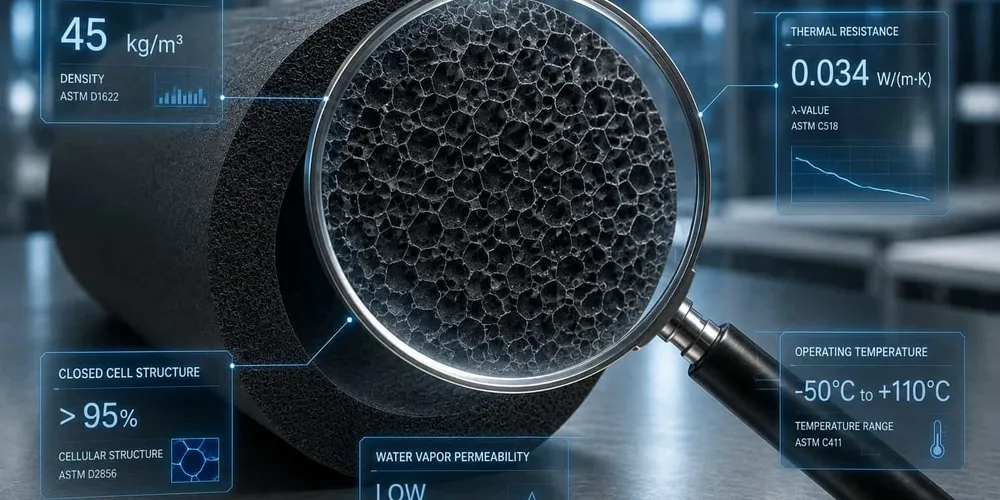
Density refers to the mass of the material per unit volume, typically expressed in kilograms per cubic meter (kg/m³), and it directly reflects the tightness of the material’s internal pore structure. So, how exactly does the density of rubber plastic insulation affect its performance?
1. Thermal Insulation Performance
The thermal insulation capability of rubber plastic cotton is closely related to its density. Generally speaking, rubber plastic insulation with a lower density exhibits superior thermal insulation effects.
This is because a lower density indicates the presence of more microscopic pores within the material. The trapped air within these pores acts as an excellent thermal insulator, drastically reducing heat transfer. However, there is a trade-off: when the density is too low, despite optimal thermal performance, the material’s mechanical strength will significantly drop, thereby negatively affecting its durability and stability in practical applications.
2. Mechanical Strength
Conversely, rubber plastic insulation with a higher density typically possesses superior mechanical strength, which includes both compressive and tensile strength.
This higher density makes the material highly resistant to deformation or damage when subjected to external pressure or pulling forces. Furthermore, higher-density rubber plastic cotton recovers its original shape much faster after being compressed, demonstrating far better elasticity. Therefore, in scenarios demanding high mechanical robustness—such as exposed pipeline insulation—selecting a higher-density rubber plastic material is much more appropriate.
3. Durability and Lifespan
Higher-density rubber plastic materials not only offer robust mechanical strength but also generally exhibit better long-term durability. They can maintain their physical properties unchanged over extended periods, significantly prolonging the material’s service life.
However, excessively high density can cause the material to become overly rigid and stiff, which limits its flexibility in certain complex installations. Therefore, when sourcing rubber plastic insulation, engineers must carefully balance the relationship between thermal performance, mechanical strength, and durability based on the specific usage environment.
4. Acoustic and Sound Absorption Performance
Beyond thermal resistance and mechanical strength, density also heavily dictates the acoustic performance of the material.
Materials with a moderate density typically offer the best sound absorption results. This is because extremes—either excessively high or excessively low densities—will disrupt how sound waves propagate and dissipate through the material. For applications requiring excellent acoustic conditioning, such as conference rooms and concert halls, selecting rubber plastic insulation with an appropriate, moderate density is critical.
The Optimal Density Range
In conclusion, when it comes to the density of rubber plastic insulation, neither “the higher the better” nor “the lower the better” applies; instead, there is an optimal “sweet spot”.
Generally, the comprehensive performance of rubber plastic insulation is completely optimized when its density falls within the 45 kg/m³ to 60 kg/m³ range. Within this specific parameter, the material successfully maintains excellent thermal and acoustic properties while possessing sufficient mechanical strength and long-term durability, perfectly meeting the demands of diverse application scenarios.
Summary
The density of rubber plastic insulation has a profound and significant impact on its overall performance profile. When selecting these materials for your engineering projects, it is imperative to comprehensively consider the specific environmental conditions and project demands, ensuring you choose the optimal density range for the best practical performance.