On this page
- Article Outline for Rubber-Plastic Insulation Buyers
- What Are Rubber-Plastic Insulation Materials?
- Fire Rating Means Reaction to Fire, Not Fire Resistance
- Which Fire Performance Indicators Matter?
- Fire Evidence Review Matrix
- How to Check a Fire Test Report
- How Thermal Conductivity Fits the Decision
- Applications of Rubber-Plastic Insulation Materials
- Procurement Checklist for Rubber-Plastic Pipes and Sheets
- FAQ About Rubber-Plastic Insulation Materials
- Final Recommendation for Project Buyers
- Standards and Editorial Sources
Rubber-plastic insulation should not be accepted on the strength of a short fire-rating label alone. A reliable assessment checks the cited standard, the complete classification, the tested product construction, smoke and flaming-droplet results, and whether the report covers the thickness and installation planned for the project.
Fire behavior is tied to a specific test specimen. A result for one thickness, facing, joint system, or mounting condition may not cover another.
Article Outline for Rubber-Plastic Insulation Buyers
| Section | Buyer question | Practical outcome |
|---|---|---|
| Material definition | What is being purchased? | Confirm product form, base material, facing, adhesive, and closed-cell construction. |
| Classification | What does the reported class cover? | Identify the standard, edition, full class, and market where it applies. |
| Test evidence | Was the quoted product actually tested? | Match model, thickness, density, facing, substrate, and installation orientation. |
| Fire behavior | What happened during the test? | Review ignition, flame spread, heat release, smoke, and flaming droplets where applicable. |
| System performance | Does the assembly match the project? | Check joints, adhesives, penetrations, supports, and adjacent materials. |
| Procurement | What should appear in the submittal? | Request traceable reports, datasheets, declarations, and batch identification. |
What Are Rubber-Plastic Insulation Materials?
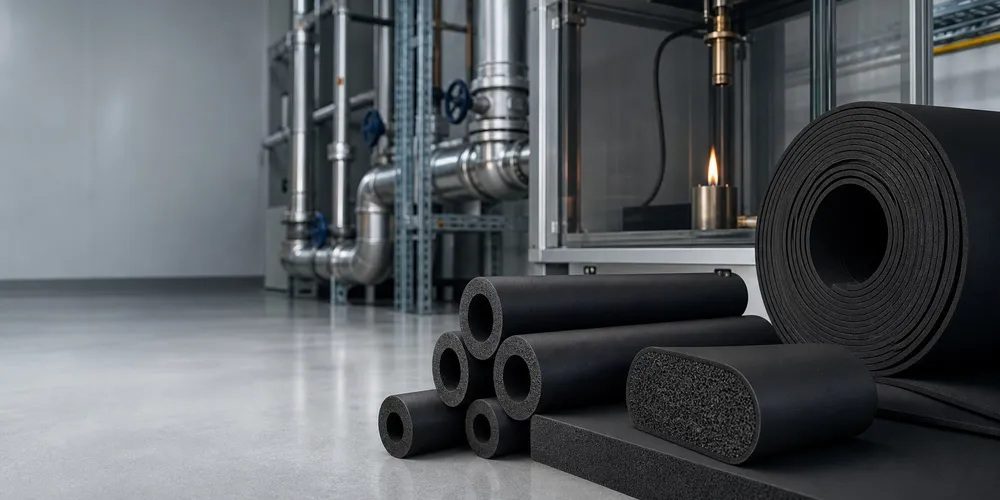
Rubber-plastic insulation materials are flexible foam products used to limit heat transfer and surface condensation on pipes, ducts, vessels, and equipment. Products in this category are commonly supplied as preformed tubes, sheets, or rolls. Many formulations use an elastomeric base with other polymers, additives, pigments, and processing aids, but the exact composition varies by manufacturer and grade.
The enclosed cells slow heat movement and help resist water-vapor entry when the installation remains intact. “Rubber-plastic” is a broad commercial description, not a complete fire specification.
Why the Product Form Changes the Evidence
Rubber-Plastic Pipes and sheets may share a formulation but use different thicknesses, seams, adhesives, or facings. A tube report should not be assumed to cover every sheet or faced construction.
Record the Exact Construction Before Comparing Reports
Record the product name, thickness, dimensions, facing, adhesive, seam type, and intended substrate before comparing reports.
Fire Rating Means Reaction to Fire, Not Fire Resistance
For insulation products, a reaction-to-fire classification describes how a product contributes when exposed to fire under defined test conditions. Fire resistance is different. It usually describes how an element such as a wall, floor, door, or penetration system maintains functions such as integrity or insulation for a period of time.
Flexible pipe insulation is not a substitute for a tested firestop or penetration system.
Read the Full Classification, Not One Letter
Classification systems can report several characteristics. Depending on the applicable market, these may include flame spread, heat release, smoke production, and flaming droplets or particles. In the European framework, linear pipe thermal insulation uses classes with the subscript “L,” and supplementary smoke and droplet indicators can form part of the result.
The European Commission framework distinguishes linear pipe thermal insulation from general construction products. Copy the complete classification exactly as reported.
Confirm the Standard Edition and Jurisdiction
Standards change. ISO lists ISO 11925-2:2026 as the current fifth edition of the direct small-flame ignitability test, published in January 2026. The method uses vertically oriented specimens under defined exposure conditions. It measures a specific part of fire behavior; it is not, by itself, a complete building-code approval.
The project specification and local authority decide which classification route is acceptable.
Which Fire Performance Indicators Matter?
Review ignition, flame spread, heat, smoke, flaming droplets, and behavior after the ignition source is removed. Not every test measures every indicator.
Ignitability and Flame Spread
Small-flame tests examine ignition and flame travel during controlled exposure. They do not reproduce every developed fire condition.
Heat Release and Fire Growth
Heat-release data indicate how a product may contribute to fire development. Confirm that the classification report follows the required test route.
Smoke Production
Treat smoke performance as measured evidence. Ask for the result or smoke class, test method, specimen details, and report limitations.
Flaming Droplets and Particles
Where applicable, check the flaming-droplet or particle result together with the complete classification.
Fire Evidence Review Matrix
Article Main Text: Fire Evidence Review Matrix
| Evidence item | What a useful document should show | Warning sign |
|---|---|---|
| Classification report | Full class, product identity, standard and edition, laboratory, issue date, and scope | A cropped certificate showing only a class or logo |
| Product description | Material type, dimensions, thickness, density where relevant, facing, and model | The quoted model cannot be matched to the report |
| Specimen construction | Tube or sheet form, joints, adhesive, substrate, orientation, and conditioning | No information on how the specimen was assembled |
| Fire results | Required ignition, flame spread, heat, smoke, or droplet results for the classification route | Marketing words replace measured results |
| Field of application | Permitted thicknesses, substrates, facings, orientations, and end-use limits | “Suitable for all applications” without a defined range |
| Traceability | Report number, issuing body, production reference, and consistent product naming | Different names appear on the datasheet, label, and report |
| Project acceptance | Consultant or authority review against the actual specification | Supplier assumes a foreign report guarantees local approval |
How to Check a Fire Test Report
Match the manufacturer, product family, grade, and construction in the report to the quotation. Check the issue date, standard edition, laboratory, specimen, mounting, substrate, field of application, and annexes.
Match Thickness, Facing, Adhesive, and Joints
Thickness, facing, adhesive, and seams can change the tested construction. Keep the proposed assembly within the report’s stated coverage.
Ask for Clarification When the Scope Is Silent
If a report does not cover another thickness, facing, or mounting condition, treat the point as unresolved and request clarification.
How Thermal Conductivity Fits the Decision
The Thermal Conductivity of Rubber-Plastic Insulation Materials describes heat transfer under stated test conditions. Compare values at the same mean temperature and by compatible methods. Thermal data do not replace fire evidence.
Compare Thermal Data at the Same Mean Temperature
Ask for the conductivity value, method, mean temperature, and tolerance. Condensation design must also consider humidity, pipe temperature, thickness, vapor-seal continuity, and supports.
Applications of Rubber-Plastic Insulation Materials
Applications of Rubber-Plastic Insulation Materials include refrigeration, chilled-water, HVAC, compatible hot-water, process-pipe, duct, and equipment systems. Selection depends on temperature, condensation, exposure, damage, and fire rules.
HVAC and Refrigeration Services
On cold services, open seams, compressed sections, or poorly sealed supports can allow moisture to reach the pipe and reduce performance.
Industrial Insulation Materials
Industrial Insulation Materials are systems. Insulation, adhesive, facing, supports, cladding, and inspection must suit the process environment and published limits.
Separate Process Hazards from Building Classification
A building-product class does not evaluate every process hazard. Follow the plant owner’s engineering rules and risk assessment.
Procurement Checklist for Rubber-Plastic Pipes and Sheets
Request the full classification and test reports, datasheet, installation instructions, destination-market documents, sample identification, and labels. For repeat shipments, confirm that the product and evidence remain unchanged.
Ten Questions to Send a Supplier
- Which product model, form, and thickness were tested?
- Which standard, edition, and complete classification apply?
- What substrate, adhesive, facing, and joint method were used?
- Are smoke and flaming-droplet results included where required?
- What field-of-application limits appear in the report?
- How is the delivered batch traced to the approved product?
FAQ About Rubber-Plastic Insulation Materials
Q1. What Are Rubber-Plastic Insulation Materials in simple terms?
Rubber-plastic insulation materials are flexible, usually closed-cell foam products supplied as tubes, sheets, and rolls for thermal insulation and condensation control. The product grade defines its performance scope.
Q2. How should I evaluate the fire evidence for Rubber-Plastic Pipes?
Match the report to the quoted pipe insulation, including standard, edition, dimensions, thickness, mounting, classification, and application limits. Kingsenda reports service to more than 165 countries and annual exports of 30 million pieces; these company-supplied figures do not replace product test evidence.
Q3. How do buyers compare Industrial Insulation Materials without relying on advertising?
Compare temperature range, conductivity at the same mean temperature, vapor behavior, fire evidence, dimensions, installation, and traceability. Kingsenda states that it can provide CE, RoHS, and FCC documentation; confirm which document applies to the ordered product and market.
Q4. What does Thermal Conductivity of Rubber-Plastic Insulation Materials tell me?
It describes heat transfer under stated conditions. Compare compatible methods and mean temperatures, then calculate thickness for the actual pipe and environment. Conductivity does not describe fire performance.
Q5. What are the main Applications of Rubber-Plastic Insulation Materials?
They are used on HVAC, refrigeration, chilled-water, compatible hot-water, process-pipe, duct, and equipment systems. Match the grade to temperature, condensation, fire, exposure, and installation requirements.
Q6. What documents should come with Rubber-Plastic Insulation Materials?
Request the datasheet, complete classification and reports, installation instructions, market documents, and batch identification. Kingsenda’s company-supplied export figures may indicate experience, but they do not replace approval of the exact product.
Final Recommendation for Project Buyers
Evaluate the material as a tested construction, not generic black foam. Define the application, identify the required classification system, match the report to the proposed product, and confirm its field of application before ordering.