On this page
- What Is Closed Cell Insulation?
- Is Rubber Foam Insulation Closed Cell?
- How the Closed Cells Are Formed
- Closed Cell Pipe Insulation Benefits
- Closed Cell Rubber Foam Insulation Limits
- Open Cell and Closed Cell Materials
- Common Elastomeric Foam Applications
- Installation Details That Matter
- Buyer Checklist for Closed Cell Foam
- Frequently Asked Questions
- Final Answer
Yes. Elastomeric rubber foam used for HVAC and pipe insulation is generally classified as flexible closed cell insulation. Its foam contains many small cells that are largely separated from one another, rather than an open network through which air and moisture can move freely.
That category description is useful, but it does not prove the performance of every product. Cell structure, closed-cell content, thermal conductivity, water-vapor transmission, temperature range, fire behavior, density, and tolerances vary by formulation and grade. Buyers should verify the exact product data rather than relying only on the words “closed cell.”
What Is Closed Cell Insulation?
Closed cell insulation is a foam material whose gas-filled cells are mostly enclosed by solid cell walls. The cells trap gas and restrict internal air movement, which helps resist heat transfer. Their separation also limits continuous paths for liquid water and water vapor.
Closed Cells Are Not Completely Impermeable
“Closed cell” does not mean that no moisture can ever pass through the material. Vapor can still move through polymers over time, and cuts, seams, punctures, joints, or damaged surfaces can create easier routes. Performance should be described with measured vapor data, not an absolute waterproof claim.
Cell Structure Is Only One Property
Two closed-cell products can have different conductivity, density, flexibility, temperature limits, smoke behavior, and mechanical strength. Material classification explains structure; it does not replace the technical data needed for a project.
Is Rubber Foam Insulation Closed Cell?
Rubber foam insulation for building services is commonly manufactured with a predominantly closed-cell structure. Many commercial grades use nitrile rubber-based formulations, often described as NBR or NBR/PVC, while other elastomeric formulations also exist.
Flexible Organic Foam Classification
Elastomeric foam belongs to the broad group of organic polymeric foam insulation. Unlike rigid boards made from some other foamed polymers, it remains flexible enough to wrap pipes, elbows, valves, ducts, and irregular equipment surfaces.
Product Form Does Not Change the Principle
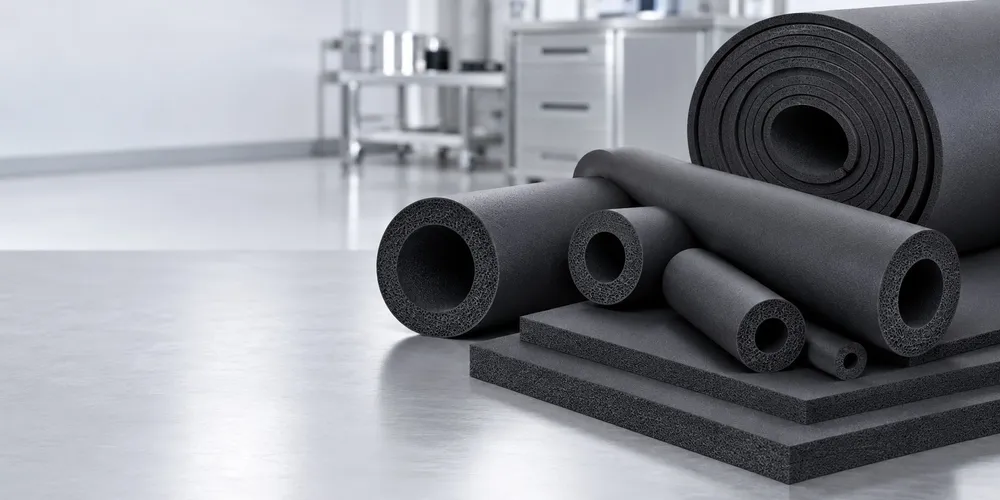
Tubes, sheets, and rolls can all use the same closed-cell concept. Preformed tubes suit straight pipe runs. Sheets cover large pipes, ducts, vessels, and fittings. Rolls support broad surfaces and fabrication work. The precise properties still depend on the selected grade and thickness.
How the Closed Cells Are Formed
Manufacturers mix a polymer base with curing agents, foaming agents, fillers, stabilizers, pigments, and other processing ingredients according to the formulation. Heat and controlled processing create gas within the material as the polymer structure forms.
Foaming Creates Independent Microcells
When the process is controlled correctly, the expanding gas produces many fine cells separated by polymer walls. Cell size and distribution affect appearance, consistency, flexibility, and performance. Exact production methods and formulations remain manufacturer-specific.
Curing Stabilizes the Foam
Curing helps the elastomeric matrix retain its shape and flexibility. The final product is cooled, cut, formed, or laminated into tubes and sheets. Quality control is important because variation in dimensions or cell structure can affect installed performance.
Closed Cell Pipe Insulation Benefits
Closed cell pipe insulation combines thermal resistance with useful resistance to water-vapor movement. This combination is especially relevant on below-ambient pipes, where heat gain and condensation must be controlled together.
Trapped Gas Slows Heat Transfer
The gas held inside the cells has low thermal conductivity relative to solid materials. The cell walls restrict convection within the foam. Actual conductivity depends on temperature, formulation, density, aging, and the test method used.
Vapor Resistance Supports Cold Service
The absence of a continuous open pore network can make water-vapor movement more difficult. This supports chilled-water and refrigeration applications, provided all seams, fittings, supports, and terminations form a continuous system.
Flexibility Simplifies Complex Details
Flexible foam can be cut and formed around elbows, tees, reducers, valves, and branches. Fewer rigid segments may reduce joint count, but flexibility should not be used to stretch a tube over an oversized pipe or compress it heavily at supports.
Closed Cell Rubber Foam Insulation Limits
Closed cell rubber foam insulation is not automatically suitable for every temperature, fire requirement, outdoor exposure, or mechanical load. Its limitations should be reviewed with the same care as its benefits.
Open Joints Can Defeat Vapor Control
A closed-cell core cannot protect an exposed pipe at an open seam. Longitudinal joints, butt joints, sheet edges, valve closures, and terminations need full contact and the approved adhesive or sealing method.
Compression Reduces Installed Thickness
Pipe supports and tight clamps can crush flexible foam. Stretching also thins the insulation wall. Reduced thickness can create a colder outer surface and a local condensation risk. Load-bearing inserts or support systems may be required.
Outdoor Exposure Needs Protection
Sunlight, weather, impact, birds, and maintenance traffic can damage unprotected foam. Suitable coatings, jackets, or cladding may be needed. Protection should remain compatible with the foam and should not puncture or compress it.
Temperature and Fire Limits Vary
Service-temperature ranges and fire classifications belong to specific products and tested assemblies. Buyers should check the exact foam, thickness, facing, adhesive, mounting method, test standard, and report scope required by the project.
Open Cell and Closed Cell Materials
Open-cell and fibrous insulation materials contain interconnected voids that allow air or vapor to move more readily through the structure. They can still provide effective thermal and acoustic performance, but cold-service systems may depend more heavily on a separate continuous vapor retarder.
Fibrous Materials Serve Different Uses
Glass wool and rock wool are fibrous materials rather than flexible elastomeric foams. Their structures support sound absorption and broad-area insulation. They should not be described simply as inferior because they use a different moisture-control strategy.
Rigid Closed-Cell Foams Are Different
Rigid foams can also have closed-cell structures. They may provide high compressive strength and panel-based coverage, while flexible elastomeric foam fits complex pipework more easily. Product choice should follow the assembly, temperature, load, moisture, and fire requirements.
Common Elastomeric Foam Applications
Elastomeric foam insulation is commonly considered for chilled-water pipes, refrigerant lines, compatible hot-water services, selected ducts, tanks, vessels, valves, pumps, and equipment connections.
Chilled-Water and Refrigeration Pipes
Below-ambient systems benefit from insulation that manages heat gain and vapor movement together. Required thickness depends on pipe temperature, ambient temperature, relative humidity, airflow, pipe size, conductivity, and the desired safety margin.
Installation Details That Matter
Correct installation preserves thickness and vapor-control continuity. Pipe surfaces should be clean, dry, and compatible with the specified adhesive before work starts.
Use the Correct Tube Diameter
A tube should fit the pipe without excessive stretching. Oversized material may leave air gaps, while undersized material can thin the wall and stress the seam. Dimensions and tolerances should be checked before bulk installation.
Seal Fittings and Terminations
Elbows, valves, tees, flanges, gauges, and ends need carefully fabricated pieces. Tape should not hide poorly joined foam. Maintenance covers should be capable of returning to their intended thermal and vapor-control condition.
Inspect Before Concealment
Inspectors should check exposed metal, open seams, loose closures, compressed supports, punctures, and incomplete penetrations before ceilings, jackets, or equipment panels hide the work.
Buyer Checklist for Closed Cell Foam
Before approving a quotation, request:
- Base material and exact product grade.
- Tube or sheet dimensions and tolerances.
- Thermal conductivity with test temperature and method.
- Water-vapor transmission or resistance data.
- Service-temperature range and installation limits.
- Fire-performance documents for the actual construction.
- Approved adhesives, tapes, coatings, and support details.
- Packaging, labeling, traceability, and destination documents.
Frequently Asked Questions
Is Elastomeric Foam Open or Closed Cell?
Elastomeric foam used for pipe insulation is generally a flexible, predominantly closed-cell material. Buyers should confirm the exact product structure and measured properties on its data sheet.
Is Closed Cell Foam Waterproof?
Not in every condition. Closed cells resist liquid-water uptake and vapor movement, but joints, damage, immersion, weather, and test conditions affect system performance.
Does Closed Cell Foam Stop Condensation?
It can support condensation control when thickness keeps the outer surface above dew point and all joints, fittings, supports, and terminations remain sealed.
Is Rubber Foam Suitable for Chilled Water?
It is commonly used on chilled-water pipes when the grade, thickness, temperature range, vapor performance, fire evidence, and installation system match the project.
Is Glass Wool a Closed-Cell Foam?
No. Glass wool is an inorganic fibrous insulation material. It uses a different structure and often relies on a facing or vapor-retarder system for below-ambient applications.
What Should Importers Verify?
Importers should verify product-specific thermal, vapor, dimensional, temperature, and fire data. Kingsenda can help match available tubes, sheets, and accessories to an inquiry, while final approval remains with the project designer and local authority.
Final Answer
Elastomeric rubber foam is generally classified as flexible closed cell insulation. Its separated cell structure supports thermal control and resistance to water-vapor movement, which explains its use on HVAC and refrigeration pipe systems. Reliable performance still depends on the exact product, calculated thickness, sealed joints, protected supports, compatible accessories, and correct installation.