On this page
- What Cold Storage Insulation Must Do
- What Is NBR Rubber Foam Insulation?
- Where Rubber Foam Fits Cold Stores
- Refrigeration Pipe Insulation Thickness
- How Condensation Control Can Fail
- Refrigeration Pipe Insulation Installation
- Selecting Cold Storage Insulation Materials
- Buyer Information for a Quotation
- Frequently Asked Questions
- Final Guidance for Cold Storage Projects
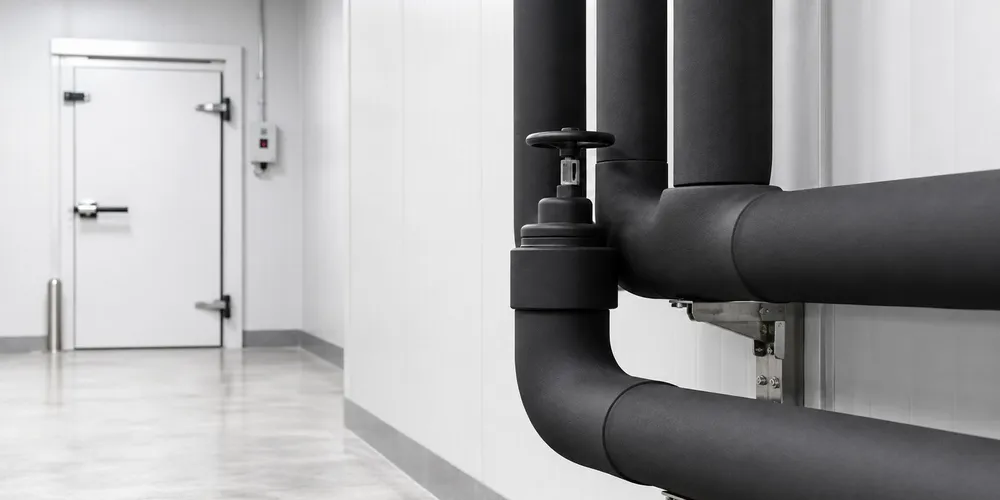
NBR rubber foam insulation is suitable for many cold-storage refrigeration pipes and equipment surfaces because its flexible closed-cell structure can slow heat gain and limit water-vapor movement. It is especially useful around elbows, valves, branches, and other shapes that are difficult to cover with rigid products.
This does not mean one foam specification will work everywhere in a cold store. Operating temperature, ambient humidity, pipe size, insulation thickness, joint sealing, supports, and protective finishes all influence the result. Buyers should evaluate the full insulation system rather than the material name alone.
What Cold Storage Insulation Must Do
Cold-storage systems work below the temperature of their surroundings. Insulation must reduce unwanted heat flow while helping the outer surface remain above the local dew point. It also needs to remain serviceable through operation, maintenance, and temperature changes.
Limit Heat Gain Into the System
Heat entering a refrigeration line adds to the load that the system must remove. The amount depends on the temperature difference, pipe size, insulation conductivity, installed thickness, surrounding air movement, and thermal bridges. Correct insulation can reduce this heat gain, but the expected saving must come from a project calculation.
Control Surface Condensation
Condensation forms when a surface is colder than the dew-point temperature of nearby air. Cold rooms, loading areas, plant rooms, and service corridors may experience different humidity conditions. A design that remains dry in one zone may condense in another.
Remain Stable at Service Temperature
The insulation grade, adhesive, tape, coating, and jacket must all suit the lowest and highest service temperatures. Buyers should confirm declared temperature limits from the supplier. General statements such as “low-temperature resistant” do not replace product-specific data.
What Is NBR Rubber Foam Insulation?
NBR rubber foam insulation is a flexible elastomeric foam commonly based on nitrile rubber and PVC material systems. It is available as tubes, sheets, and rolls for refrigeration, HVAC, plumbing, and equipment insulation. Exact composition and declared performance vary by product.
Closed Cells Limit Vapor Movement
A closed-cell foam contains many small cells that are largely separated from one another. This structure restricts the route available for water vapor and trapped gas helps resist heat flow. Cuts, open seams, punctures, and compressed areas can still interrupt the vapor-control layer.
Flexibility Helps With Complex Shapes
Flexible tubes fit straight refrigeration lines, while sheets can be fabricated around larger pipes, vessels, valves, and irregular equipment. The material can follow bends without rigid segmented pieces, but it should not be stretched so far that its wall becomes thinner than specified.
Where Rubber Foam Fits Cold Stores
Rubber foam is commonly considered for refrigeration pipework and equipment connections rather than as a universal replacement for every cold-room panel or floor material. Each part of the building has different structural, thermal, fire, and moisture requirements.
Refrigerant and Suction Lines
Below-ambient refrigerant pipes need continuous thermal and vapor control. Straight tubes can reduce the number of fabricated joints, while careful fitting is still required at couplings, branches, supports, and changes in diameter.
Valves, Elbows, and Flanges
Valves and fittings create common weak points because their shapes require more cutting and joining. Every piece should meet without exposed cold metal. Items that need maintenance may require removable insulation covers that can be resealed after service.
Equipment and Plant-Room Piping
Selected refrigeration equipment surfaces and plant-room pipes can be insulated with compatible sheets or tubes. The equipment manufacturer, system designer, and local requirements should determine where insulation is permitted and how access, ventilation, drainage, and maintenance are preserved.
Refrigeration Pipe Insulation Thickness
Refrigeration pipe insulation thickness cannot be chosen from pipe diameter alone. The calculation needs the fluid or pipe temperature, ambient temperature, relative humidity, pipe material, insulation conductivity, surface finish, air movement, and required condensation safety margin.
Use the Actual Design Conditions
Published thickness charts are useful only when their assumptions match the project. A humid loading dock and a controlled plant room do not have the same condensation risk. Designers should check both normal operation and credible high-humidity conditions.
Compare Conductivity Correctly
Thermal conductivity changes with temperature and may vary by product grade. Buyers should compare values reported with the same units, mean temperature, test method, and specimen condition. A low number without test context is not enough for thickness selection.
Allow for Supports and Thermal Bridges
Pipe hangers can compress insulation or connect cold metal to surrounding structures. Compatible load-bearing inserts and continuous vapor seals may be required. The design should also address clamps, penetrations, instrument connections, and other repeated thermal bridges.
How Condensation Control Can Fail
Even correctly selected cold storage insulation materials can fail when the installed vapor-control path is incomplete. Moist air tends to find joints and damaged areas, which is why workmanship has a strong effect on cold-service performance.
Open Seams Expose Cold Surfaces
Longitudinal seams, butt joints, sheet edges, and terminations need full contact and the approved closure method. Tape should not be used to conceal a gap. The joint below it must already be properly formed and sealed.
Compressed Foam Loses Thickness
Stretching a tube onto an oversized pipe or crushing insulation beneath a support changes the installed geometry. Thin areas may have a lower thermal resistance and a colder outer surface. Installers should use the correct tube size and support detail.
Damaged Finishes Need Repair
Outdoor or exposed services may require UV-resistant coatings, jackets, or cladding. Mechanical-room insulation can also be damaged by tools and maintenance traffic. Repairs should restore both thermal coverage and vapor-control continuity with compatible materials.
Refrigeration Pipe Insulation Installation
Good refrigeration pipe insulation installation creates a dry, continuous layer across straight runs, fittings, supports, and terminations. The pipe surface should be clean, dry, and suitable for the specified adhesive before insulation begins.
Plan Around Fittings and Access
Installers should identify valves, sensors, drains, unions, and service points before cutting material. Planned pieces generally produce fewer uncontrolled joints than small offcuts. Required access must remain usable without leaving permanent gaps.
Seal Joints as Work Progresses
Joints should be completed according to the insulation and adhesive manufacturer’s instructions. Leaving long sections open for later sealing increases the chance of contamination, poor alignment, or trapped moisture.
Inspect Before Covering the Work
Inspection should occur before jackets, ceilings, labels, or equipment panels hide the insulation. The review should cover exposed metal, open seams, compressed areas, loose closures, damaged surfaces, and incomplete penetrations.
Selecting Cold Storage Insulation Materials
Project buyers should match the product to the use location and required evidence. Foam tubes for small refrigeration lines, sheets for equipment, and insulated building panels serve different purposes and should not be treated as interchangeable products.
Review Product-Specific Data
Ask for thermal conductivity with its test temperature, water-vapor transmission data, service-temperature range, dimensions, tolerances, density, facing or coating options, and the required fire-performance documents. Reports should identify the exact product and tested construction.
Confirm Accessories and Protection
An insulation system may need adhesive, cleaner, tape, support inserts, coatings, jackets, or cladding. These components should be compatible with the foam and the service environment. Substituting an accessory without checking compatibility can weaken the completed system.
Buyer Information for a Quotation
Provide the supplier with:
- Refrigerant type and operating temperatures.
- Pipe material, outside diameter, and total length.
- Ambient temperature and relative humidity.
- Required insulation thickness or calculation basis.
- Indoor, outdoor, concealed, or exposed locations.
- Quantities of elbows, tees, valves, and flanges.
- Support, coating, jacket, and adhesive requirements.
- Destination-market documents and labeling needs.
Frequently Asked Questions
Is Rubber Foam Suitable for Cold Storage?
Rubber foam is suitable for many refrigeration pipes and equipment surfaces when its temperature range, thickness, vapor performance, fire evidence, and installation system match the project.
Does Closed-Cell Foam Stop Condensation?
No material stops condensation automatically. The design must keep the outer surface above dew point and maintain sealed seams, fittings, supports, and terminations.
How Is Refrigeration Thickness Selected?
Thickness is calculated from operating and ambient conditions, pipe size, material conductivity, surface properties, and project requirements. There is no universal thickness for every cold store.
Can Rubber Foam Cover Valves?
Yes, compatible sheets can be fabricated around many valves and irregular parts. The detail must preserve insulation continuity while allowing required maintenance access.
Does Rubber Foam Insulate Cold-Room Walls?
Rubber foam is mainly discussed here for refrigeration services and equipment. Cold-room walls, ceilings, and floors usually require complete panel or building-envelope systems selected for structural and thermal needs.
What Should Importers Ask Suppliers?
Importers should request product-specific data, test reports, tolerances, accessory requirements, packaging details, and traceable identification. Kingsenda can help match available formats to the inquiry, while final approval remains with the project designer and local authority.
Final Guidance for Cold Storage Projects
NBR rubber foam insulation can be a practical choice for refrigeration pipes and complex equipment details in cold-storage projects. Reliable performance depends on correct thickness, sealed joints, protected supports, compatible accessories, and inspection. Buyers should evaluate the complete system and project conditions instead of relying on a broad material claim.