On this page
As an indispensable component in modern construction and industrial sectors, rubber plastic insulation has garnered widespread attention and application due to its excellent thermal performance and eco-friendly properties. Manufactured from rubber and plastic through specialized processing techniques, these materials exhibit outstanding thermal insulation, moisture resistance, and flame retardancy, making them highly suitable for a variety of fields requiring thermal management.
Next, we will explore the different rubber plastic insulation products, their specific thickness ranges, and the exact fields where they are applied.
1. Overview of Rubber Plastic Insulation
Rubber plastic insulation features a unique closed-cell structure that effectively blocks air convection and heat transfer, thereby achieving exceptional thermal insulation results.
Simultaneously, this material possesses excellent waterproof and moisture-proof capabilities, allowing it to maintain stable insulation performance even in highly humid environments. Furthermore, its reliable flame-retardant properties effectively prevent the occurrence and spread of fire accidents.
2. Product Types and Thickness Applications
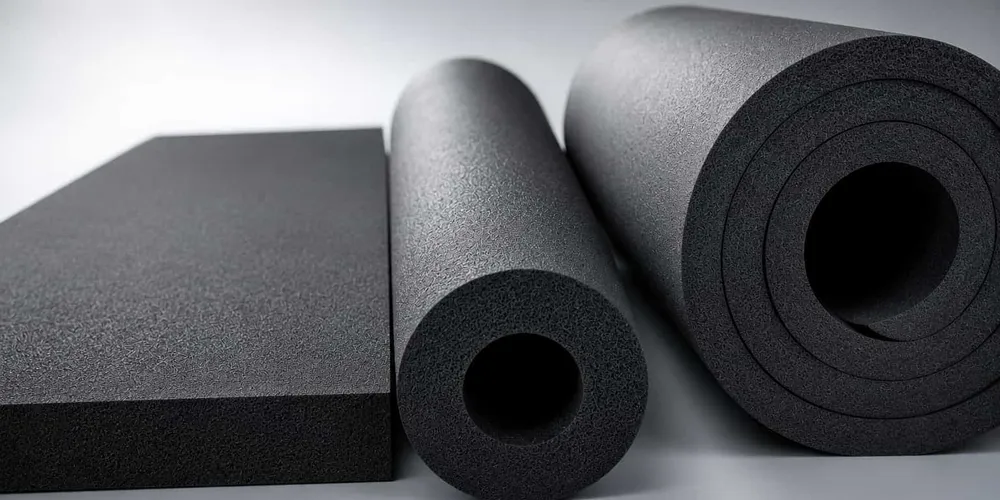
2.1 Rubber Plastic Insulation Boards
The rubber plastic insulation board is a common format, with thicknesses typically ranging from 5mm to 30mm.
- Thinner Boards: Suitable for general building exterior wall insulation, roof insulation, and standard pipe wrapping.
- Thicker Boards: Ideal for facilities with stringent thermal requirements, such as cold storage rooms and refrigerated trucks.
2.2 Rubber Plastic Insulation Pipes
Rubber plastic insulation pipes are primarily designed for insulating piping systems. The required thickness is determined by the pipe’s diameter and the specific insulation requirements; generally, larger pipe diameters necessitate thicker insulation layers.
- Applications: They are widely applied to hot water pipes, steam pipes, and air conditioning piping systems to effectively minimize energy loss and boost overall system efficiency.
2.3 Rubber Plastic Insulation Blankets (Rolls)
The rubber plastic insulation roll is an easy-to-install and easy-to-cut material with a broad thickness range, varying from 3mm to 50mm.
- Thinner Rolls: Suitable for areas with lower insulation demands, such as indoor partition walls and suspended ceilings.
- Thicker Rolls: Utilized in locations with high insulation requirements, including heavy industrial plants and cold storage facilities.
3. Core Application Fields
3.1 The Construction Industry
In the architectural sector, rubber plastic insulation is extensively used for exterior walls, roofs, and flooring. These materials significantly reduce building energy consumption while enhancing the living comfort of occupants. Additionally, their moisture-resistant and flame-retardant properties contribute to elevated building safety standards.
3.2 The Industrial Sector
Within industrial applications, rubber plastic insulation is predominantly used for piping systems, heavy equipment, and storage tanks. It effectively curtails energy loss, thereby improving industrial production efficiency. Moreover, its strong corrosion resistance allows it to seamlessly adapt to various complex and harsh working environments.
3.3 Cold Storage and Cold Chain Logistics
Rubber plastic insulation plays a crucial role in the refrigeration and cold chain logistics industries. It efficiently maintains low-temperature environments, guaranteeing the quality and safety of food, pharmaceuticals, and other sensitive goods during transit and storage. Key applications in this field include cold storage facilities, refrigerated transport vehicles, and insulated shipping boxes.
4. Future Development Trends
As the global energy crisis intensifies and environmental awareness grows, the application prospects for rubber plastic insulation are becoming increasingly broad. In the future, these materials will evolve to become more efficient, eco-friendly, and intelligent.
- Performance Upgrades: Continuous improvements in production processes and material formulas will further enhance thermal performance and long-term durability.
- Sustainability: The adoption of renewable materials and biodegradable technologies will minimize the material’s negative environmental impact.
- Smart Integration: Combining these materials with the Internet of Things (IoT) and Big Data will enable the intelligent management and control of insulation systems.
Conclusion
As a highly efficient and environmentally friendly thermal solution, rubber plastic insulation plays a vital role across construction, industrial manufacturing, and cold chain logistics. With continuous technological advancements and expanding application fields, the future development of rubber plastic insulation is highly promising.